

EU Ministers Back Tougher Curbs on Trade with Israeli Settlements
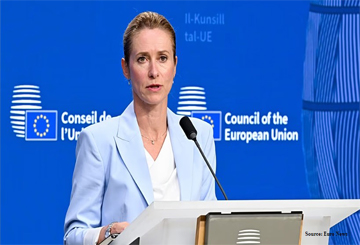
BRUSSELS: European Union foreign ministers have expressed broad support for imposing tougher restrictions on trade with Israeli settlements in the occupied Palestinian territories, with a majority favoring a complete ban on imports of settlement-made goods, according to the EU’s foreign policy chief, Kaja Kallas.
The issue was discussed during a closed-door meeting of EU foreign ministers in Brussels on Monday, where ministers reviewed a set of proposals prepared by the European Commission aimed at limiting trade with Israeli settlements, which the European Union considers illegal under international law.
Speaking after the meeting, Kallas said the proposal receiving the strongest backing was a full ban on imports of goods produced in Israeli settlements.
“The option that got the most support was banning the trade with the illegal settlements,” Kallas told reporters.
The discussions mark one of the strongest indications yet that the European Union may be moving toward stricter economic measures against Israeli settlements amid growing international concern over the situation in the occupied West Bank.
Majority Supports Trade-Based Approach
A key outcome of Monday’s discussions was growing support among EU member states for treating the proposed restrictions as a matter of trade policy rather than foreign policy.
If categorized as trade legislation, the measures could be approved through the EU’s qualified majority voting system, requiring the support of at least 15 member states representing 65% of the bloc’s population. This would eliminate the need for unanimous approval from all 27 member countries, a hurdle that has previously blocked similar initiatives.
Several countries, including Belgium, France, Ireland, Luxembourg, the Netherlands, Spain and Sweden, have argued that restrictions on settlement products fall under trade law and therefore should not require unanimous political agreement.
Dutch Foreign Minister Tom Berendsen said the proposed measures should clearly be regarded as trade policy.
“These are trade measures, so that means that, as far as we are concerned, that should be possible with a qualified majority,” he said.
Commission Proposal Moves to Next Stage
EU ambassadors will now examine the European Commission’s proposals in greater detail and begin drafting a more comprehensive legal framework.
The Commission last week circulated a preliminary two-page options paper outlining several possible measures, ranging from limited trade restrictions to a complete ban on settlement products.
Kallas said an extraordinary meeting of EU foreign ministers could be convened before the next scheduled ministerial meeting in October if additional political progress is needed.
Diplomats have expressed concern that delaying the issue until October could complicate negotiations, as Israel is expected to hold parliamentary elections shortly afterward.
Divisions Remain Within EU
Despite growing support for stronger measures, differences remain among member states.
Italian Foreign Minister Antonio Tajani suggested that the European Union should avoid adopting new measures before Israel’s elections, signaling continued caution among some governments.
Several ministers also criticized the European Commission for presenting what they described as an incomplete proposal after months of delay.
Belgian Foreign Minister Maxime Prévot said the proposal lacked sufficient detail and questioned the Commission’s commitment to moving the process forward.
Spanish Foreign Minister José Manuel Albares urged the bloc to act more decisively, arguing that banning trade with Israeli settlements would simply reflect existing international legal obligations rather than represent a political decision.
Existing EU Policy
The European Union already distinguishes between products manufactured inside Israel and those produced in Israeli settlements located in occupied Palestinian territories.
Settlement goods are excluded from preferential tariff treatment under the EU-Israel Association Agreement and do not benefit from the same trade advantages as products originating within Israel’s internationally recognized borders.
However, the EU has not imposed a complete ban on settlement products, despite growing political pressure from several member states.
International Law Adds Pressure
Momentum for stronger action has increased following a 2024 advisory opinion issued by the International Court of Justice (ICJ), which concluded that Israeli settlements in the occupied Palestinian territories are unlawful under international law.
The court also stated that countries should avoid economic activities that could contribute to maintaining or expanding the settlements, adding legal support to calls for stricter trade restrictions.
The European Union has consistently maintained that Israeli settlements violate international law, a position also supported by numerous United Nations resolutions.
Debate Over Legal Authority
The question of whether the proposed trade restrictions require unanimous approval has become a central point of disagreement within the EU.
Critics have accused European Commission President Ursula von der Leyen of delaying progress by arguing that any ban should be treated as a foreign policy measure requiring unanimous backing from all member states.
Kallas, however, said the Council of the European Union’s legal services had issued an opinion indicating that settlement trade restrictions could legally be adopted through qualified majority voting.
“We need to have a unified position,” Kallas said, adding that if sufficient political support exists, the bloc has the legal basis to move forward under qualified majority rules.
The discussions are expected to continue in the coming weeks as EU ambassadors prepare detailed proposals that could eventually form the basis of one of the bloc’s most significant policy decisions regarding Israeli settlements in recent years.
