

US Has ‘Dismantled’ Islamabad Memorandum, Muscat Talks Focused Only on Strait of Hormuz: Iran
Iran says Washington violated key provisions of Islamabad Memorandum, rejects Trump’s claims on Muscat talks, rules out IAEA inspections of damaged nuclear sites
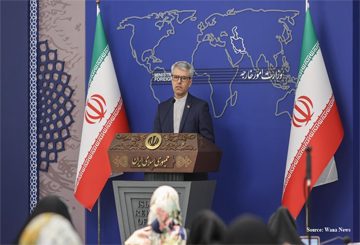
TEHRAN: Iranian Foreign Ministry spokesperson Esmaeil Baghaei has accused the United States of dismantling key provisions of the Islamabad Memorandum within weeks of its implementation, saying Washington repeatedly violated its commitments while Iran had remained committed to the agreement.
Addressing a weekly press briefing in Tehran on Monday, Baghaei said the memorandum had entered a period of crisis because of repeated U.S. breaches, adding that negotiations held in Muscat were exclusively focused on the implementation of Article Five concerning the Strait of Hormuz and did not include discussions on Iran’s nuclear programme or any other issue.
US accused of violating Islamabad Memorandum
Baghaei said Iran had entered the Islamabad Memorandum in good faith and had consistently honored its obligations, but accused Washington of failing to uphold its commitments from the outset.
“The United States did not even allow the one-month implementation period under Article Five to run its course,” he said, alleging that Washington had begun reversing its commitments immediately after the agreement came into force.
According to Baghaei, the United States dismantled several of the memorandum’s 14 provisions within a short period, pushing the agreement into what he described as a serious crisis.
He reiterated that Iran’s policy remained “commitment for commitment,” stressing that Tehran would continue implementing its obligations only if the other party fulfilled its own responsibilities.
“No one can accuse Iran of violating the agreement,” Baghaei said, adding that as long as Washington continued violating the memorandum, Iran would also suspend implementation of its corresponding commitments.
Muscat talks limited to Strait of Hormuz
Rejecting remarks by U.S. President Donald Trump that Iran had agreed to all outstanding issues during talks in Muscat before allegedly attacking ships shortly afterward, Baghaei described the claims as false.
He said discussions in Oman were solely devoted to Article Five of the Islamabad Memorandum, which relates to the management and security of navigation through the Strait of Hormuz.
According to the Iranian spokesperson, Tehran had worked closely with Oman to establish a mechanism ensuring the safe passage of commercial vessels through the strategic waterway, but those efforts failed because of what he described as overt and covert U.S. pressure on Muscat.
Baghaei categorically denied that nuclear issues or any other political matters were discussed during the negotiations.
“Reports claiming otherwise are entirely false,” he said.
Iran defends interpretation of Article Five
Baghaei said Article Five of the Islamabad Memorandum was drafted in clear language to prevent any arbitrary interpretation by the United States, reflecting Iran’s longstanding mistrust of Washington.
He urged observers to compare both the Persian and English versions of the agreement, insisting the text clearly assigns Iran responsibility for implementing security arrangements concerning the Strait of Hormuz in consultation with Oman.
According to Baghaei, the provision was included because Iran believed the strait and its southern shores had been used during the conflict to undermine its national security.
As the country with the longest coastline along the Persian Gulf and the Gulf of Oman, Iran considered it both its right and responsibility to safeguard maritime security while preventing activities it regarded as threatening its sovereignty.
He said Iran’s objective remained ensuring safe international shipping through the Strait of Hormuz while protecting its national security.
US actions blamed for maritime tensions
Baghaei alleged that recent U.S. military strikes on Iran’s southern coastal regions disrupted implementation of Article Five and prevented Tehran from carrying out the agreed mechanism during the initial 30-day period.
He further accused Washington of encouraging regional states to establish alternative shipping routes outside the agreed framework with Iran.
According to Baghaei, those actions violated the memorandum, increased maritime risks, encouraged some vessels to switch off tracking systems, raised the possibility of collisions and environmental incidents, and contributed to escalating regional tensions.
Iran to pursue legal action over recent conflict
The Iranian spokesperson said seeking justice for those killed during recent U.S. and Israeli military operations had become a national priority.
He described accountability for alleged crimes committed over the past 40 days and during the earlier 12-day conflict as a political, legal and moral obligation, arguing that such crimes would never be subject to statutes of limitation.
Baghaei said Iran’s Foreign Ministry would document the incidents through international legal mechanisms while the country’s judiciary would continue domestic legal proceedings against those considered responsible.
He also criticized what he described as attempts by Iran’s opponents to portray themselves as victims despite, in his words, having committed acts of aggression against Iran.
Iran rejects return of IAEA inspectors
Responding to questions regarding requests by International Atomic Energy Agency (IAEA) Director General Rafael Grossi to inspect damaged Iranian nuclear facilities, Baghaei said Tehran would not permit inspectors to return.
He gave no indication that Iran intended to reconsider the decision.
Comments on Afghanistan and Lebanon
Baghaei announced that Iran’s deputy foreign minister for consular affairs would soon visit Afghanistan to discuss border management, consular cooperation, trade and people-to-people ties.
He said Iran shared more than 900 kilometres of border with Afghanistan and would continue practical cooperation while keeping the issue of formally recognizing Kabul’s government separate until legal conditions were met.
On Lebanon, Baghaei said the Islamabad Memorandum emphasized respect for Lebanon’s sovereignty and rejected suggestions that any external power could determine the country’s future.
He also reiterated Iran’s longstanding position that preserving national sovereignty required adequate defensive capabilities, arguing that countries facing occupation or military aggression had the right to defend themselves.
Europe criticized over regional stance
The Iranian spokesperson dismissed a joint statement by Britain, France and Germany criticizing Iran’s actions in the Strait of Hormuz, calling it one-sided and lacking legitimacy.
He accused the three European countries of reversing the facts and pursuing policies that, in his view, encouraged instability rather than contributing to peace.
Baghaei also criticized what he described as Europe’s continued policy of appeasement, saying respect for international law and the principles of the United Nations should guide European positions on regional conflicts.
US domestic politics
Commenting on political developments in Washington, Baghaei said divisions within the United States had produced contradictory foreign policy messages.
He maintained that disagreements among different branches of the U.S. political establishment were increasingly shaping Washington’s international conduct but stressed that Iran would remain focused on protecting its national interests.
He also dismissed allegations that Iran had discussed any alleged plot against President Donald Trump through indirect communications, saying the issue had never been part of negotiations conducted through intermediaries.
