

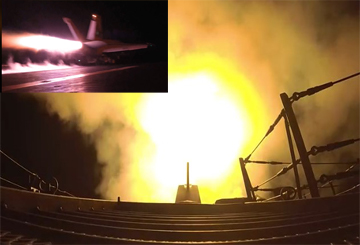
CENTCOM says it hit dozens of Iranian military targets in second night of strikes
The Strait of Hormuz is a vital maritime corridor for global trade. Iran does not control it. U.S
WASHINGTON: The United States launched a fresh wave of overnight airstrikes across multiple locations in Iran early Monday, targeting military infrastructure and coastal defense systems, as tensions between Washington and Tehran intensified despite an interim agreement aimed at reducing hostilities.
According to the US Central Command (CENTCOM), the latest military operation began at approximately 2100 GMT on Sunday, following nearly 140 strikes carried out the previous night. The operation targeted what CENTCOM described as dozens of Iranian military sites, including air defense systems, coastal radar installations, missile and drone capabilities, and small naval vessels.
In a statement posted on X, CENTCOM said the strikes were intended to degrade Iran’s ability to launch attacks against international shipping in the Strait of Hormuz, one of the world’s most strategically important maritime routes through which a significant portion of global oil supplies pass.
Iranian state media confirmed that several areas in southern and western Iran came under attack, including Qeshm Island, Bandar Abbas, located near the Strait of Hormuz, and sites in Khuzestan province, which borders Iraq.
Reports also indicated that Farur Island, situated east of Qeshm in the Persian Gulf, was struck during the operation. According to Iran’s official news agency IRNA, the attack killed a telecommunications worker and injured four others.
“Following the attack of the American enemy on Monday morning, one person was martyred and four others were injured,” IRNA reported.
Iranian authorities later claimed that the country’s Islamic Revolutionary Guard Corps (IRGC) launched retaliatory strikes targeting Jordan, Bahrain, and Kuwait, further expanding the regional scope of the conflict.
On Sunday, Kuwait announced that three northern land border posts had sustained damage in an attack, while an offshore drilling platform was reportedly hit by what officials described as a hostile drone. Kuwaiti authorities said one person was injured in the incident.
Meanwhile, air raid sirens sounded across Bahrain early Monday after authorities warned of renewed attacks targeting the Gulf kingdom, which hosts the US Navy’s Fifth Fleet.
Bahrain’s Interior Ministry urged residents and citizens to remain calm and seek shelter in the nearest safe location.
“The siren has been sounded… citizens and residents are urged to remain calm and head to the nearest safe place,” the ministry said in a statement posted on X.
The latest escalation follows an Iranian attack early Sunday on a commercial vessel transiting the Strait of Hormuz. The ship reportedly caught fire, forcing its crew to abandon the vessel.
Following that incident, Iran’s Revolutionary Guards declared that the Strait of Hormuz would remain closed until further notice, linking the decision to continue US military operations in the region.
“The Strait of Hormuz will be closed until the end of American interventions in this region,” IRNA quoted the IRGC as saying.
However, CENTCOM rejected the claim, insisting that the strategic waterway remains open to lawful maritime traffic.
“The Strait of Hormuz is open to all vessels seeking to lawfully transit,” the US military command said, adding that American forces remain deployed in the region to ensure freedom of navigation.
“Iran does not control the strait. Traffic is flowing,” CENTCOM stated.
The renewed exchange of military action marks another significant deterioration in regional security and raises concerns over the safety of international shipping, energy supplies, and the possibility of a broader conflict involving Gulf States and US forces stationed across the region.
