

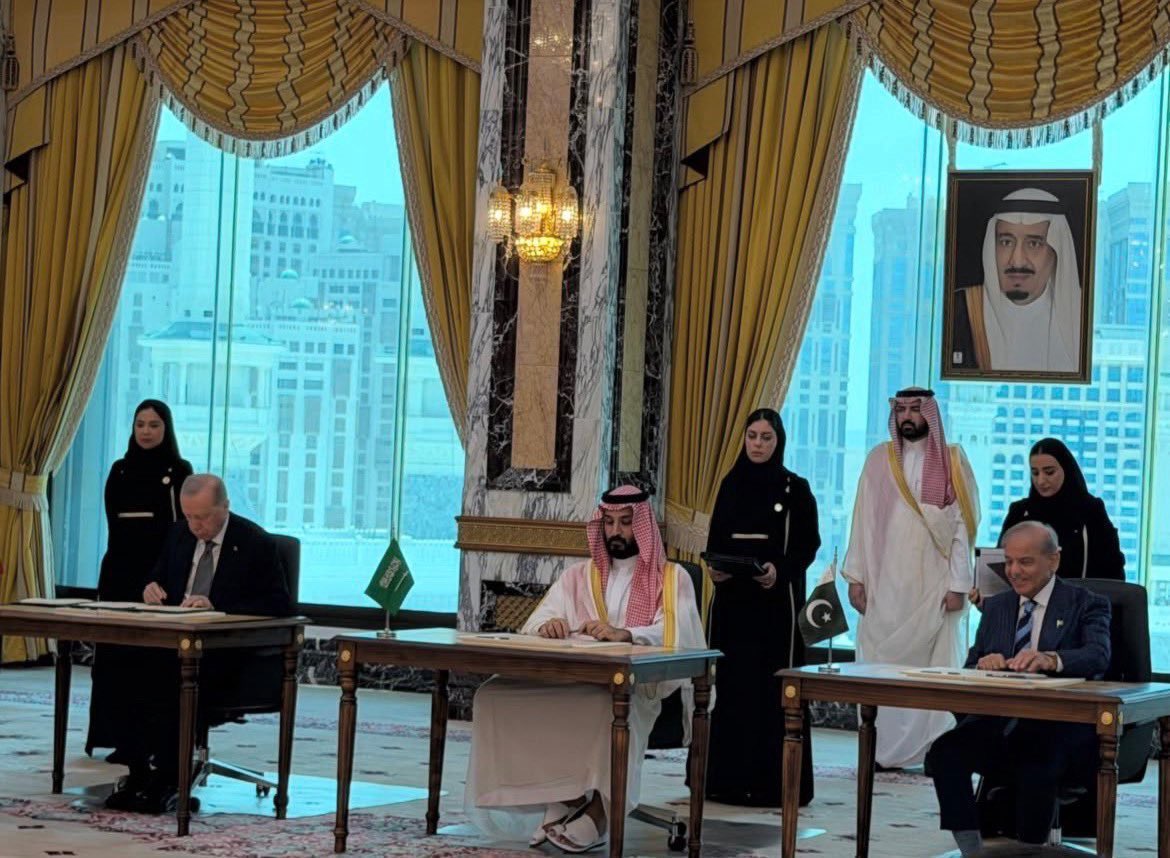
Full text of the Mecca defence pact signed by Turkiye, Saudi Arabia and Pakistan
The agreement commits the three countries to mutual defence, military assistance, and intelligence sharing and defence industry cooperation, barring withdrawal for the first 10 years
Following its submission for parliamentary approval, the text of the Makkah Joint Defense Agreement has been published by Turkey’s state broadcaster, TRT Haber, and other media outlets. The 16 articles of this trilateral defense agreement are presented below.
The Government of the Republic of Türkiye, the Government of the Islamic Republic of Pakistan, and the Government of Saudi Arabia (hereinafter referred to as “Party,” “Parties,” or “Primary Parties”).
Article 1: The “Parties” shall cooperate to ensure and safeguard each other’s independence, sovereignty, territorial integrity, and the inviolability of their internationally recognized borders. Should the territorial integrity, sovereignty, or internationally recognized borders of any “Party” face a threat or danger, the “Parties” shall employ all necessary means to eliminate such threat(s) or danger(s).
Article 2: An armed attack originating from an external source against any “Party” shall be considered an attack against all the “Parties.” If any of the “Parties” becomes the target of an armed attack or military aggression by another country or group of countries, the “Parties” shall provide immediate assistance to the targeted “Party,” utilizing all available means of mutual support. To this end—and in order to facilitate the exercise of the right to self-defense as recognized under Article 51 of the United Nations Charter—the “Parties” shall determine the scope and nature of the support to be provided, following an objective assessment of the assistance required. They shall cooperate within the limits of their available resources, including military assets and capabilities. Article 3: In accordance with Article 2 of this Agreement, the “Parties” shall cooperate closely in the fields of defense, the defense industry, and security; foster relations between their respective armed forces; and undertake agreed-upon activities aimed at strengthening defense cooperation.
Article 4: The “Parties” shall hold regular consultations on matters of international security. They shall provide consistent and effective mutual assistance and cooperate in developing individual and joint measures—based on shared assessments—to safeguard their vital interests and national security, and to eliminate threats and risks to their national security.
Article 5: The “Parties” shall strengthen existing cooperation and joint efforts—including at the operational level—to combat terrorism in all its forms and manifestations, which severely impact regional and international stability and security.
Article 6: In times of both war and peace, the “Parties” shall encourage the exchange of personnel between their defense institutions, joint training programs and exercises, as well as deployments and activities designed to enhance the interoperability of their armed forces, with the objective of advancing their defense capabilities.
Article 7: To strengthen their defense capabilities, the Parties shall—based on mutual agreement—support cooperation among defense industry entities, including through technology sharing, joint technology development, joint production, and collaboration in the following areas:
- a) Encouraging joint production within the defense sector. b) Implementing defense innovation through joint research and development projects in technologies requiring specialized expertise.
- c) Training personnel and providing support to the military industry within the territories of the “Parties,” facilitated by experts from any of the “Parties.”
- d) Sharing expertise and lessons learned in the fields of the defense industry, defense research and development, and innovation.
- e) Other areas of cooperation mutually agreed upon by the “Parties.”
Article 8:
The “Parties” shall establish a “Strategic Political and Defense Committee”—comprising the Foreign Ministers, Defense Ministers, and Chiefs of General Staff of the “Parties”—to provide strategic direction for joint defense, promote defense and security cooperation among the “Parties,” and address any obstacles arising during the implementation of this Agreement. The Committee shall meet twice a year, with hosting duties rotated among the “Parties.” If deemed necessary, the leaders of the “Parties” may meet once a year.
The “Strategic Political and Defense Committee” may establish sub-committees if it deems them necessary.
Agreements or protocols shall be negotiated between the “Parties,” where required, to facilitate the implementation of the areas of cooperation proposed in this Agreement.
The “Strategic Political and Defense Committee” shall be empowered, upon the consensus of the “Parties,” to determine and approve the procedures and principles governing the accession of other “Parties” to this Agreement. A secretariat will be established in the Kingdom of Saudi Arabia to serve the “Strategic Political and Defence Committee.” The secretariat will enter into a headquarters agreement with the Kingdom of Saudi Arabia.
