

Iran Draws Red Line over Hormuz, Araghchi Claims Waterway Lies within Iranian and Omani Waters
Iranian foreign minister says Tehran and Muscat have mapped alternative passage routes, but Oman’s position and the agreement’s details remain unclear.
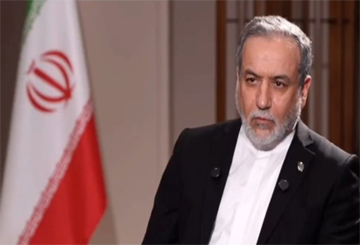
TEHRAN: In an interview with Iraq’s Al-Ikhbariya TV, Iranian Foreign Minister Abbas Araghchi has claimed that the Strait of Hormuz lies within the territorial waters of Iran and Oman, arguing that the strategically important waterway is not an international strait in the sense suggested by those who oppose its closure.
In remarks concerning the legal status and navigation arrangements of the strait, Araghchi said Iran and Oman had recently reached an understanding on specific routes for vessels entering and leaving the waterway. He added that a map identifying the proposed routes had been prepared.
“If the Strait of Hormuz is reopened one day, the route agreed upon by Iran and Oman will be the actual passage for ships,” Araghchi said, according to the account of his remarks.
However, the claim raises questions about the legal status of the waterway and the extent to which any bilateral agreement between Tehran and Muscat could determine international shipping arrangements. The account also notes that Oman has not publicly stated that the strait belongs exclusively to Iran and Oman.
Dispute over the Strait’s legal status
Araghchi defended Iran’s position by referring to the region’s history, saying the waterway had been administered during the era of the Kingdom of Hormuz, which he described as a sovereign entity. He argued that the historical connection extended back thousands of years.
The historical argument, however, is distinct from the modern legal framework governing maritime navigation. Under the United Nations Convention on the Law of the Sea (UNCLOS), straits used for international navigation are generally subject to a regime of transit passage, subject to the convention’s applicable provisions. The legal status of the Strait of Hormuz therefore cannot be determined solely by historical claims or a bilateral understanding.
The Strait of Hormuz connects the Persian Gulf with the Gulf of Oman and the Arabian Sea. It is one of the world’s most strategically important maritime chokepoints, serving as a major route for global oil and gas shipments.
Shipping routes and regional implications
Araghchi’s reference to an agreed map of shipping routes raises questions about the proposed arrangement, including whether it has been formally published, what areas it covers and whether Oman has officially confirmed the agreement.
Any changes to navigation arrangements in the strait could have significant implications for international trade, energy markets and maritime security. The waterway is used by commercial vessels transporting oil, liquefied natural gas and other goods to international markets.
The broader debate centres on the balance between coastal states’ sovereignty and the rights of vessels using an international navigation route. While Iran and Oman exercise sovereignty over their respective territorial seas bordering the strait, the legal regime governing passage through the waterway is also shaped by international maritime law.
Araghchi’s statements underscore Tehran’s position on the strait’s status and future navigation arrangements. However, the details of the reported Iran-Oman understanding, including the map and the scope of any agreement, would need to be independently verified before its legal or operational implications could be established.
