

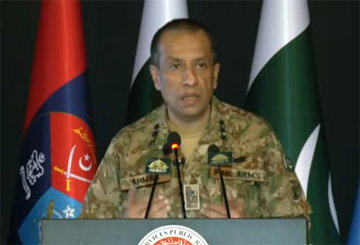
Good governance vital for Pakistan’s security, constitutional reforms possible if needed: DG ISPR
ISLAMABAD : Director General Inter-Services Public Relations (ISPR) Lieutenant General Ahmed Sharif Chaudhry on Friday said Pakistan’s long-term security depends not only on military capability but also on strong governance, stressing that constitutional administrative reforms should be considered if required to improve public service delivery.
Addressing a press conference on the country’s security situation, the military spokesperson said effective governance was a key pillar of national stability, adding that many of Pakistan’s long-standing challenges could not be resolved without strengthening the administrative system and ensuring constitutional institutions served the people efficiently.
He said Pakistan’s governance structure had remained largely unchanged despite a sharp rise in population over the past five decades.
“In 1972, Pakistan’s population was around 70 to 80 million. Today it stands at nearly 250 million, yet the country still has the same four provinces,” he said.
Lt Gen Chaudhry said the country’s changing demographic realities required serious consideration of whether the current governance model remained suitable for future needs.
He maintained that any administrative reforms must remain within the framework of the Constitution.
“If an administrative reset is needed to ensure good governance, then it should happen,” he said, adding that any decision regarding governance reforms should be taken through constitutional mechanisms with the will of the people at its core.
“If the people are satisfied with the current governance system, that is their choice. If they are not, then the issue should also be resolved in accordance with the Constitution,” he added.
The DG ISPR said strengthening governance would improve public services, reinforce state institutions and contribute directly to Pakistan’s overall security and stability.
Security forces conduct over 40,000 operations
Presenting an overview of the security situation, Lt Gen Chaudhry said security forces carried out 40,348 intelligence-based operations across the country during the current year.
According to him, 31,080 operations were conducted in Balochistan, 7,177 in Khyber Pakhtunkhwa and 2,091 in other parts of Pakistan.
He said security forces were now conducting nearly 194 intelligence-based operations daily, describing it as evidence of an uninterrupted nationwide campaign against terrorism.
The military spokesperson said 2,084 confirmed terrorists had been killed during these operations, averaging around 10 militants per day. He added that 2,597 terrorists were eliminated throughout 2025, while the current year’s figures indicated continued operational momentum.
Terrorism incidents and casualties
The DG ISPR said Pakistan had recorded 3,145 terrorism incidents so far this year, including 1,971 in Khyber Pakhtunkhwa, 1,148 in Balochistan and 26 in other regions.
He said 28 suicide attacks had taken place during 2026, alleging that the majority involved Afghan nationals, including those linked to attacks in Tank district and Karachi. He also claimed individuals associated with Afghan security forces had been involved in several suicide bombings.
Lt Gen Chaudhry said 819 Pakistanis had embraced martyrdom in terrorism-related incidents this year, including 303 military personnel, 194 police and law enforcement officials, and 322 civilians.
He said the ratio of terrorists killed compared to security personnel martyred had improved significantly, claiming that security forces were now eliminating approximately 2.5 terrorists for every martyr in 2026.
Balochistan situation
Commenting on Balochistan, the military spokesperson said a deliberate propaganda campaign was being carried out to portray the province as unstable.
He said the Constitution and laws applied equally to every citizen and stressed that loyalty to the state was a constitutional responsibility.
“Pakistan is our ultimate identity,” he said.
Lt Gen Chaudhry alleged that certain influential tribal leaders opposed educational opportunities for underprivileged children and resisted development projects in the province. He also accused some Sardars of seeking control over development funds and using violence to protect vested interests.
The DG ISPR further claimed that narcotics and diesel smuggling continued under the cover of business activities and alleged that some Sardars treated the Levies Force as a personal tribal force.
He also accused the Afghan Taliban government of supporting terrorist groups operating against Pakistan and questioned what common interests existed between Afghanistan, India and the banned Balochistan Liberation Army (BLA).
Reaffirming the state’s policy, Lt Gen Chaudhry said there was no room for negotiations with terrorists, adding that militants had only two choices: surrender their weapons or face decisive action.
Referring to Article 5 of the Constitution, he said every citizen had a constitutional duty to remain loyal to the state, adding that a “hard state” meant one where all affairs were conducted strictly according to the Constitution and the rule of law.
