

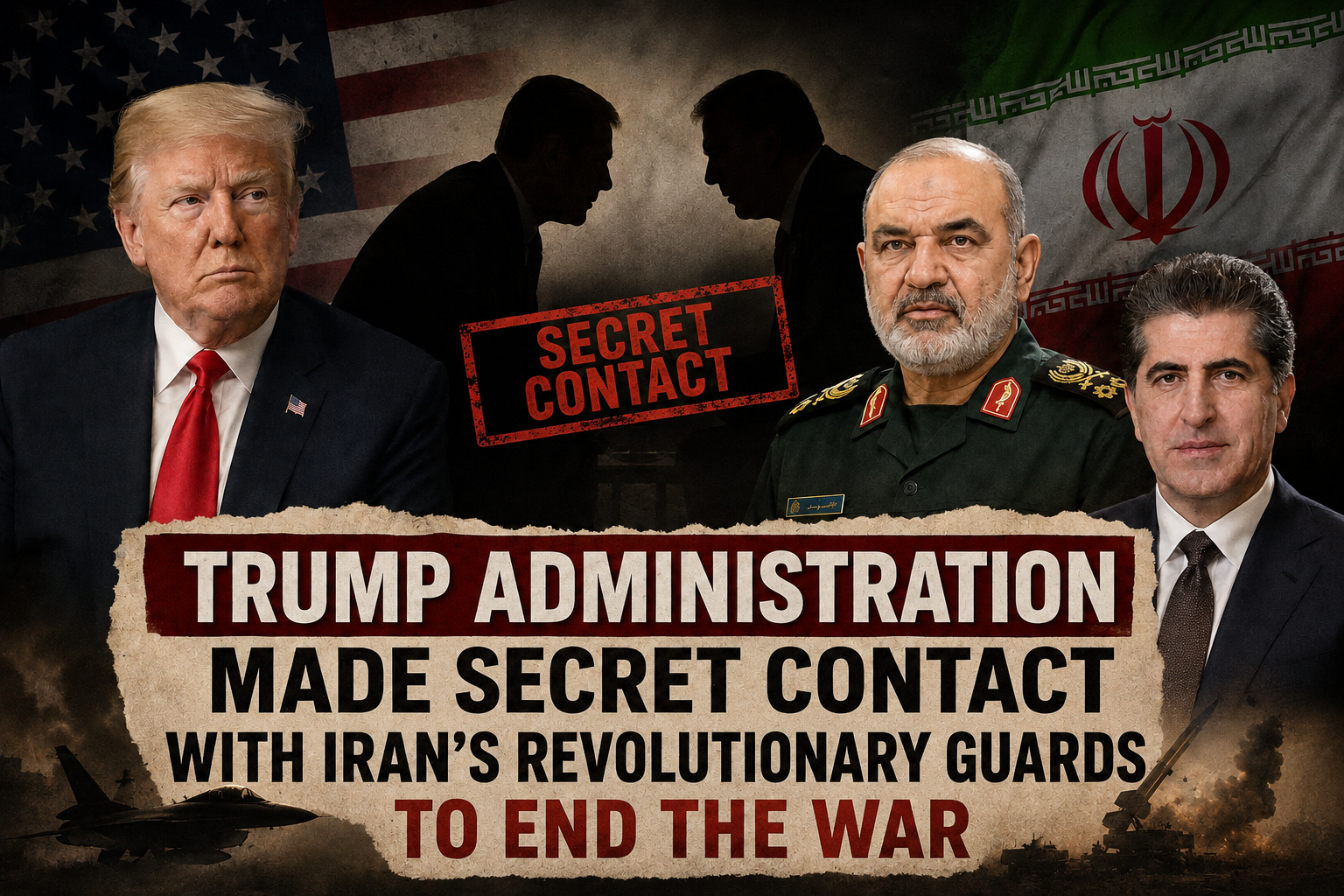
Trump Administration Secretly Reached Out to IRGC to End War
WASHINGTON: The Trump administration secretly sought direct contact with Iran’s Islamic Revolutionary Guard Corps (IRGC) in an effort to end the war after U.S. negotiators became increasingly uncertain over whether Iranian officials at the negotiating table had the authority to reach a final agreement.
According to three people with direct knowledge of the discussions, the administration bypassed Iran’s formal negotiating channel in mid-May and used Iraqi Kurdistan President Nechirvan Barzani as a backchannel to senior IRGC leadership.
The unusual diplomatic effort underscored one of Washington’s biggest challenges in dealing with Tehran: determining who actually holds decisive power over Iran’s national security and foreign policy.
According to Axios Report that the United States and Iran eventually reached a memorandum of understanding, but the arrangement quickly collapsed, leaving Washington once again searching for a reliable channel to the people who wield real influence in Tehran.
The episode also highlighted the growing political and military influence of the IRGC following weeks of intense fighting and the killing of Supreme Leader Ali Khamenei and other senior Iranian leaders.
Washington Questions Iran’s Negotiating Authority
Following an April 8 ceasefire and a subsequent summit in Islamabad, Washington and Tehran intensified efforts to negotiate an end to the conflict.
By early May, U.S. officials believed an agreement was within reach. However, Iran delayed its response for more than 10 days, prompting growing doubts inside the White House over whether its negotiators had sufficient authority to conclude a deal.
U.S. officials increasingly suspected that Parliament Speaker Mohammad Bagher Ghalibaf and Foreign Minister Abbas Araghchi, who were involved in negotiations, could be overruled by the IRGC.
That uncertainty prompted the Trump administration to look for a direct line to the powerful military organization.
Barzani Chosen for Secret Backchannel
Around May 10, then-U.S. Director of National Intelligence Tulsi Gabbard contacted Nechirvan Barzani, president of Iraq’s Kurdistan region, and asked whether he could help establish communication with IRGC Commander Gen. Ahmad Vahidi.
Barzani was considered particularly suitable because of his longstanding relationships in both Washington and Tehran. He lived in Iran during the Iran-Iraq war, studied at the University of Tehran and speaks fluent Persian.
He also maintains personal contacts with senior Iranian officials, including members of the IRGC.
According to people familiar with the conversation, Gabbard told Barzani that the White House wanted to determine whether the IRGC supported the proposals being discussed by Iranian negotiators or had additional demands of its own.
The call was reportedly made with the knowledge and approval of President Donald Trump and Vice President JD Vance.
Secret Contact With IRGC Commander
Barzani agreed to help and contacted his Iranian connections. He insisted, however, that he wanted to speak directly with Gen. Vahidi.
On May 14, an IRGC official reportedly arrived at Barzani’s office in Erbil carrying an encrypted telephone to facilitate a secure conversation.
During the call, Barzani asked Vahidi whether he supported the Iranian negotiating team and its efforts to reach an agreement with Washington.
According to a source familiar with the discussion, Vahidi responded that he fully supported the negotiators and said the IRGC preferred resolving the crisis through negotiations.
Barzani subsequently briefed Gabbard on the conversation, and the information was relayed to senior White House officials.
U.S. Proposed Secret Talks in Erbil
Following the exchange, Washington proposed holding confidential U.S.-Iran talks in Erbil, with Barzani acting as host and intermediary.
Barzani conveyed the proposal to Iranian officials. Tehran did not immediately reject the idea, but Iranian officials reportedly raised serious security concerns.
They feared that Israeli intelligence networks operating in Iraqi Kurdistan could pose a threat to Iranian representatives and potentially attempt to assassinate them either in Erbil or during their journey to and from the region.
As a result, the proposed secret meeting never took place.
Pakistan and Qatar Continue Mediation
Despite the failure of the Erbil initiative, Pakistan and Qatar have continued exchanging messages between Washington and Tehran in an effort to revive negotiations.
Regional sources familiar with the discussions said, however, that the mediation efforts have yet to produce a significant breakthrough.
Some sources also believe Pakistani officials have offered more optimistic assessments of the negotiations than the actual discussions warrant, hoping that a positive narrative could help generate momentum and break the diplomatic deadlock.
Barzani Offers to Help Again
Barzani has reportedly sent fresh messages to the White House offering his assistance in restarting direct U.S.-Iran negotiations.
The episode demonstrates the difficulties Washington faces in negotiating with Tehran at a time when the balance of power inside Iran remains uncertain.
The central challenge for any future talks will be identifying which Iranian officials genuinely have the authority to make and implement strategic decisions.
For Washington, that could make trusted intermediaries such as Barzani increasingly important.
However, former U.S. Middle East adviser Brett McGurk has argued that the main obstacle is not the choice of mediator but Iran’s policy toward the Strait of Hormuz — an issue that remains deeply contentious and is unlikely to be resolved quickly.
