

Security Forces Bust Terrorist Hideouts Inside Mosques, Recover IEDs in North Waziristan
Security forces recover large cache of IEDs, explosives and weapons during intelligence-based operation in Mir Ali; sanitisation operation launched to clear the area of terrorist infrastructure.
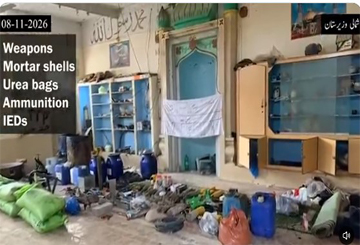
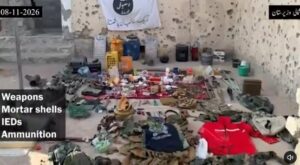
NORTH WAZIRISTAN: (News Pulse) Security forces have recovered a massive cache of improvised explosive devices (IEDs), explosives, weapons and ammunition from two terrorist hideouts established inside mosques in North Waziristan, the military’s media wing said on Monday.
According to the Inter-Services Public Relations (ISPR), the intelligence-based operation was carried out on Sunday in Muzak village, located on the southern outskirts of Mir Ali, targeting hideouts of the Indian-sponsored terrorist group Fitna Al-Khawarij.
The military’s media wing said security forces successfully sanitised two terrorist hideouts established inside mosques, where militants had allegedly stored explosive materials and operated torture cells.
“The terrorists had deliberately established hideouts in Masajid to store explosive materials and also were running torture cells there,” the ISPR said in a statement.
Strongly condemning the use of places of worship for terrorist activities, the statement described the act as a blatant desecration of mosques and a clear demonstration of the militants’ disregard for Islamic teachings.
“This reprehensible desecration of places of worship by Indian proxy Fitna Al-Khawarij serves as yet another clear piece of evidence of their utter disregard for the fundamental teachings of Islam,” the statement said.
The ISPR further maintained that terrorists allegedly receiving support from the Afghan Taliban had nothing to do with Islam, adding that their distorted interpretation and exploitation of religion were unacceptable and completely rejected by the people of Khyber-Pakhtunkhwa and Pakistan.
Following the operation, security forces launched a comprehensive sanitisation effort to identify and eliminate any remaining terrorist hideouts and infrastructure in the surrounding areas.
The military reiterated that the counterterrorism campaign under the vision of “Azm-e-Istehkam”, approved by the Federal Apex Committee on the National Action Plan, would continue with full intensity.
It reaffirmed that security forces and law enforcement agencies remained committed to eliminating the threat of foreign-sponsored and supported terrorism and restoring lasting peace across the country.
Rising Terrorist Threat
Pakistan has witnessed a persistent rise in militant violence in recent years, with attacks increasing annually since 2022, according to data compiled by the Armed Conflict Location & Event Data (ACLED), an international conflict-monitoring organisation.
The organisation recorded a nearly fourfold increase in attacks, from 658 in 2022 to 2,425 in 2025, highlighting the growing security challenges confronting the country.
The security situation remained particularly concerning in 2026. Two security reports presented to the federal cabinet in October revealed that terrorist incidents in Khyber-Pakhtunkhwa had increased by 195 per cent between March 2024 and September 2026.
The reports further indicated that 73 per cent of terrorist attacks recorded in the province during 2026 had targeted police and security personnel. The increasing use of drones and improvised explosive devices has also emerged as a major challenge for security forces.
Pakistan has repeatedly accused the Afghan Taliban authorities of providing safe havens to the banned Tehreek-e-Taliban Pakistan (TTP) on Afghan soil, enabling the group to plan and launch terrorist attacks inside Pakistan. Kabul has faced persistent calls to prevent Afghan territory from being used against neighbouring countries.
Islamabad’s concerns have also been reflected in a United Nations Security Council monitoring report published in February 2026, which stated that TTP attacks originating from Afghanistan had increased and that the group was enjoying greater operational freedom and support from Afghanistan’s de facto authorities.
The UN report also highlighted links between Al Qaeda and the TTP, noting that Al Qaeda continued to provide training and support to the militant group. It further pointed to the TTP’s acquisition of advanced weaponry, including night-vision equipment and drone systems.
Against this backdrop, security forces have intensified intelligence-based operations across the country, particularly in Khyber-Pakhtunkhwa, as part of broader efforts to dismantle terrorist networks, disrupt their logistical infrastructure and prevent further attacks.
