

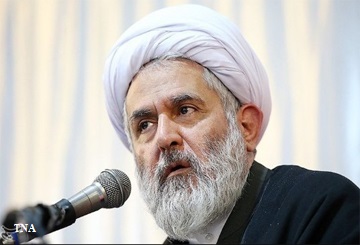
US shifts strategy against Iran after military calculations fail: Basij commander
TEHRAN: The United States has shifted from seeking a decisive military victory over Iran to applying political, social and regional pressure after its wartime calculations failed, the commander of Iran’s Basij Force said Saturday.
Hojjatoleslam Hossein Taeb said Washington had initially believed that attacks targeting Iran’s Supreme Leader, senior commanders and military and resistance infrastructure would lead to the collapse of the Islamic Republic.
But those calculations had failed, he said, arguing that Iran’s political and social system had survived the campaign and continued to resist.
Taeb said the United States had conducted an intensive bombing campaign involving up to 200 aircraft a day, while deploying B-1 and B-52 bombers and launching missiles from naval platforms.
He claimed the opposing side eventually moved toward a ceasefire after realizing that Iran’s population had maintained its resistance.
“We did not ask for a ceasefire; they moved toward a ceasefire,” Taeb said, referring to negotiations that produced a memorandum of understanding.
He alleged that the other side subsequently violated the agreement’s commitments within 60 days.
Taeb said Washington then turned to a naval blockade, seeking to put further pressure on Iran, exploit internal divisions and weaken public support for the government.
He cited US polling as showing that 71 percent of Americans believed President Donald Trump had made a mistake by going to war with Iran.
According to Taeb, Washington’s current strategy is focused on encouraging social discontent inside Iran, linking social issues to security concerns and creating domestic distractions while keeping the war itself in the background.
He also accused the United States of attempting to destabilize the region and drive a wedge between Iran and its neighbours by creating alliances against Tehran.
Taeb said those efforts had failed to isolate Iran, adding that Washington had miscalculated in seeking to unite regional countries against the Islamic Republic.
On Europe, he said European governments continued to cooperate with Washington publicly but were increasingly aware of their weakened position.
“The global map of power is changing,” Taeb said, arguing that the United States was no longer the centre of global power and Israel was no longer the dominant force in the region.
He said both were experiencing “one of their weakest conditions”, citing economic difficulties in the United States and Israel as further signs of what he described as the decline of the Western-led power structure.
