

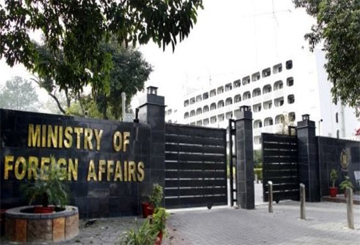
Pakistan Condemns Afghan Taliban for Using Istanbul Talks to Malign Islamabad
ISLAMABAD: Pakistan on Sunday strongly criticized the Afghan Taliban regime for using the Istanbul peace talks to malign Pakistan instead of addressing Islamabad’s primary concern: terrorism emanating from Afghan soil.
“Instead of finding solutions to Pakistan’s core concern, the Afghan regime used the opportunity to malign Pakistan through hypothetical accusations and jingoistic rhetoric,” said Foreign Office spokesperson Tahir Hussain Andrabi in a statement.
The peace talks between Pakistan and the Afghan regime have broken down, although a ceasefire continues between the two neighbors. On November 7, Defence Minister Khawaja Asif told to Media that negotiations had been suspended, with “no programme for the fourth round of talks,” describing the situation as a “complete deadlock” entering an indefinite phase.
According to the FO, observers of the talks mediated by Turkiye and Qatar could see that the Taliban were primarily interested in prolonging the temporary ceasefire without taking concrete or verifiable action against terrorist elements on Afghan soil. “They prolonged discussions and engaged in futile arguments to stonewall efforts at reaching any concrete understanding,” the statement added.
The FO recalled a significant surge in terrorist attacks originating from Afghanistan since the Taliban assumed power in August 2021. Despite suffering both military and civilian casualties, Pakistan exercised maximum restraint and avoided retaliation. “Pakistan expected the Taliban regime to control TTP/FaK and BLA/FaH elements and take tangible action against them,” the spokesperson said.
Pakistan had also sought to promote stability in Afghanistan through trade concessions, humanitarian aid, educational and medical visa facilitation, and encouraging international engagement with the Taliban for regional peace and socio-economic development. However, the Taliban response was largely limited to “hollow promises and inaction.”
“Instead of addressing Pakistan’s core expectation — preventing Afghan territory from being used for attacks against Pakistan — the Taliban regime consistently avoided taking concrete measures,” the statement said. “By confusing the main issue of terrorism with hypothetical concerns, they seek to absolve themselves of responsibilities toward the international community and their own people.”
Highlighting Pakistan’s October 2025 response to persistent attacks from Afghanistan, the FO emphasized that “TTP/FaK and BLA/FaH are declared enemies of the State of Pakistan and its people,” warning that anyone harboring, abetting, or financing these groups would not be regarded as a friend of Pakistan.
Three Rounds of Talks
The FO recalled three rounds of peace talks, stating that Pakistan has always favored diplomacy and regarded the use of force as a last resort. During the first round in Doha, the two sides reached an understanding on principles of cooperation, leading Pakistan to agree to a temporary ceasefire.
The second round in Istanbul was intended to establish an implementation mechanism for the Doha commitments, but Taliban representatives avoided action on the ground and sought to disrupt the process with provocative media statements. In the third round, Pakistan continued to push for a monitoring mechanism, while the Afghan side attempted to dilute the focus on terrorism by introducing hypothetical claims.
The statement also rejected attempts to frame Pakistani terrorists in Afghanistan as a humanitarian or refugee issue, calling it a ploy to absolve terrorists of responsibility. Pakistan affirmed its willingness to receive any Pakistani nationals from Afghanistan through designated border crossings, rather than having them pushed across armed and equipped.
While reiterating its commitment to dialogue, the FO stressed that terrorism emanating from Afghanistan must be addressed first. “Pakistan has never shied away from dialogue with any government in Kabul, but will not negotiate with terrorist groups such as TTP/FaK or BLA/FaH,” the statement said.
Internal Taliban Divisions and Pashtoon Nationalism
The spokesperson noted that some within the Taliban opposed confrontation with Pakistan, but a powerful lobby, reportedly backed by foreign actors, has stoked tensions to seek legitimacy and unify the Kabul administration. This has included abusive and outrageous allegations against Pakistan, eroding goodwill in Islamabad.
The FO also cautioned against attempts to incite Pashtoon nationalism in Pakistan, stressing that Pashtoons are an integral part of Pakistani society and urging the Taliban to focus on inclusive governance rather than fomenting cross-border discord. “While the Afghan Taliban declare terrorism as Pakistan’s internal issue, they ignore the role of Afghan individuals who have issued fatwas legitimizing attacks against Pakistan,” it said.
Pakistan reaffirmed its commitment to resolving bilateral differences through dialogue but emphasized that its core concern — terrorism emanating from Afghanistan — must be addressed first and foremost.
