

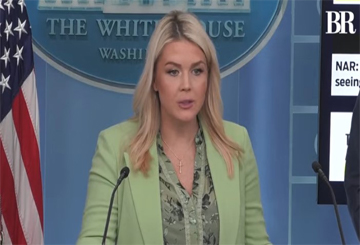
White House says discussing second round of Iran Talks in Pakistan
Press Secretary Leavitt hails Pakistan’s role, says it has been an ‘incredible mediator’ throughout the proces
The United States has signaled optimism about a potential breakthrough in its ongoing conflict with Iran, with discussions underway to hold a second round of peace negotiations in Islamabad, according to the White House.
White House Press Secretary Karoline Leavitt confirmed on Wednesday that active discussions are taking place regarding the next phase of talks. She stated that officials are “feeling good about the prospects of a deal,” adding that future negotiations would “very likely” be hosted in Islamabad.
Leavitt dismissed reports suggesting that Washington had requested an extension of the current ceasefire, calling such claims “bad reporting” and inaccurate. She emphasized that diplomatic engagement remains ongoing and productive, noting that both Donald Trump and JD Vance have expressed confidence in the negotiation process.
Pakistan’s Role as Key Mediator Praised
The White House highlighted Pakistan’s central role in facilitating communication between Washington and Tehran. Leavitt described Pakistan as an “incredible mediator,” noting that it has been instrumental in keeping negotiations on track.
Despite offers from multiple countries to assist, President Trump has reportedly chosen to streamline diplomatic efforts through Pakistan alone to ensure efficiency and clarity in communication.
Trump Claims China Will Not Arm Iran
In a separate development, President Trump stated that China has agreed not to supply weapons to Iran, a move he suggested could significantly reduce regional tensions.
Posting on his Truth Social platform, Trump also announced his intention to permanently reopen the Strait of Hormuz, a vital global oil transit route.
He claimed that Chinese President Xi Jinping supports the decision and indicated an upcoming visit to Beijing on May 14–15—his first trip to China during his second presidential term.
Naval Blockade Raises Tensions Despite Talks
Tensions remain high following the US decision to impose a naval blockade on Iran, effectively halting maritime trade. The blockade, implemented earlier this week, has already disrupted oil shipments and commercial traffic, which accounts for roughly 90% of Iran’s economy.
Trump described the ongoing war as “very close to over” in an interview, suggesting that a resolution could come either through diplomacy or decisive military action.
However, Iranian officials have warned that the blockade could violate the ceasefire and provoke retaliation. Senior military commander Ali Abdollahi stated that Iran may respond by shutting down trade routes across the Persian Gulf, the Sea of Oman, and the Red Sea if the blockade continues.
Iran Signals Willingness for Dialogue, Rejects Pressure
Iranian leadership has maintained that it seeks dialogue rather than conflict. President Masoud Pezeshkian reiterated that Iran “does not seek war or instability,” while warning that any attempt to impose foreign will on the country would fail.
Meanwhile, Foreign Ministry spokesperson Esmaeil Baghaei confirmed that communication between Iran and the US is continuing indirectly through Pakistan. A Pakistani delegation is expected to arrive in Tehran to deliver further messages as part of ongoing diplomatic exchanges.
Sticking Points: Nuclear Program and Sanctions
Despite progress, significant disagreements remain. A key issue is Iran’s nuclear program:
The US has proposed a 20-year suspension of nuclear activity
Iran has suggested a shorter 3–5 year pause
Additionally, Washington insists that Iran export its enriched nuclear material, while Tehran demands the lifting of international sanctions.
Rafael Grossi, head of the International Atomic Energy Agency, noted that the duration of any agreement would ultimately be a political decision and hinted that compromise may be possible.
Regional Conflict Complicates Peace Efforts
The situation is further complicated by ongoing military actions involving Israel and Hezbollah in Lebanon. While the US and Israel argue these operations fall outside the ceasefire, Iran maintains they are connected.
The conflict, which began on February 28, has resulted in approximately 5,000 deaths, including casualties in both Iran and Lebanon.
Global Impact and Economic Reactions
The conflict has had a major impact on global markets, particularly energy. The disruption of the Strait of Hormuz—through which a significant portion of the world’s oil passes—has affected supply chains across Asia and Europe.
However, renewed diplomatic optimism has helped stabilize markets slightly, with oil prices falling and Asian stock markets showing gains.
Outlook: Fragile Optimism Amid Uncertainty
While both sides appear open to negotiations, the situation remains fragile. US officials suggest talks could resume within days in Islamabad, though no official date has been confirmed.
President Trump expressed confidence that a deal is achievable, stating that Iran is eager to negotiate. However, he also warned that military options remain on the table if diplomacy fails.
As diplomatic channels remain active and tensions persist, the coming days are expected to be critical in determining whether the conflict moves toward resolution—or further escalation.
