

Guterres’ Final UNGA Address: ‘Fighting Must Stop’ as UN Chief Demands AI Rules, Climate Action
Outgoing UN chief calls for global oversight of artificial intelligence, renewed peace efforts and sweeping reforms of international institutions under mounting geopolitical pressure
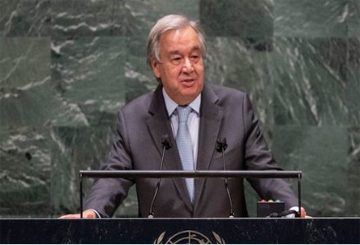
UNITED NATIONS, New York: United Nations Secretary-General Antonio Guterres used his final address to the General Assembly on Tuesday to deliver a sweeping appeal for global action, urging world leaders to regulate artificial intelligence, end conflicts, confront climate change and overhaul international institutions he warned are increasingly struggling to meet the challenges of a rapidly changing world.
Guterres, whose second five-year term ends on December 31, used the high-profile address to reflect on a decade at the helm of the United Nations, during which he sought to strengthen the organisation’s role as a mediator in conflicts and a forum for international cooperation on emerging technologies.
With nearly 130 world leaders gathered in New York for the annual General Assembly session, Guterres warned that the international system is under growing strain as major powers increasingly act outside UN mechanisms and disagreements continue to paralyse collective action.
“Those countries leading this technological revolution must share information on emerging safety risks, cooperate on testing and evaluation – and work towards common safeguards that protect us all,” Guterres told the assembly.
He called for a multilateral framework to manage the risks posed by artificial intelligence, backed by “credible and independent oversight,” while urging governments to establish safeguards that can keep pace with the rapid development of increasingly powerful AI systems.
The UN Security Council is also preparing to host a briefing involving AI leaders, highlighting the growing recognition that artificial intelligence has implications not only for economic development but also for international peace and security.
Guterres has emerged as a prominent advocate for global AI governance. In 2023, the United Nations established a 39-member advisory body on artificial intelligence, bringing together technology executives, government officials and academics from countries including the United States, Russia and Japan.
The Security Council held its first meeting focused on AI risks that year. China warned that the technology must not become a “runaway horse”, while the United States raised concerns about its potential use for censorship and repression.
‘The Fighting Must Stop’
Guterres also devoted significant attention to conflicts in the Middle East, calling for an immediate reduction in tensions and renewed diplomacy as instability continues to threaten regional security and international trade.
Referring to tensions surrounding the Red Sea and the Strait of Hormuz, he called for “de-escalation and dialogue” and urged countries to uphold international law and protect freedom of navigation.
“Together, let’s send a clear message from this hall: The fighting must stop. Humanitarian aid must flow. And navigational rights and freedoms must be fully restored in accordance with international law,” he said.
His remarks drew sustained applause when he reiterated support for a two-state solution to the Israeli-Palestinian conflict and demanded greater international action to address the humanitarian consequences of war.
Guterres also renewed his climate message, declaring that “polluters must pay” and urging governments to accelerate efforts against climate change.
UN Under Pressure
The outgoing secretary-general acknowledged the growing criticism directed at the United Nations, particularly from the administration of US President Donald Trump, as Washington has withdrawn from or reduced support for several UN bodies and cut funding.
“Our mechanisms for collective action are under growing strain,” Guterres said, warning that global institutions continue to reflect “the power realities and interests of a largely bygone age.”
His comments came as the absence of several major leaders underscored the diplomatic challenges facing the organisation. Chinese President Xi Jinping and leaders from countries including South Africa, India and Germany did not attend the high-level gathering in New York.
Guterres argued that the international system needs reforms capable of reflecting contemporary geopolitical realities and ensuring that global institutions can respond effectively to emerging crises.
A Decade at the UN
The address marked the beginning of Guterres’ farewell to many of the world leaders with whom he has worked during his nearly decade-long tenure.
He leaves office at a time when the UN faces multiple crises, including wars, climate change, humanitarian emergencies, geopolitical rivalry and rapid technological transformation.
Yet Guterres ended his final General Assembly address on a message of perseverance, insisting that international peace remains possible despite the deep divisions confronting the world.
“So, on January 1st, when I am no longer Secretary-General, be sure of this. Wherever I will be, whatever I will be doing – I will keep championing the conviction that peace is possible,” he said.
“I will continue to stand up for the values of the United Nations Charter and I will never, ever give up.”
He then thanked the assembly, bringing his final address as UN secretary-general to a close.
