

Carney Rejects ‘Rival Bloc’ Label as Canada Pushes for Deeper EU Alliance
Canadian PM says closer Europe ties are about resilience and sovereignty as Trump threatens heavy tariffs over proposed partnership
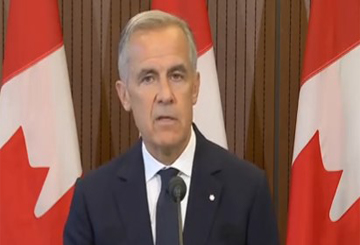
LONDON: Canadian Prime Minister Mark Carney has rejected the idea that closer ties between Canada and the European Union are intended to create a rival geopolitical bloc against the United States, saying the proposed partnership is instead aimed at strengthening economic resilience, protecting sovereignty and expanding cooperation between democratic partners.
Speaking to European lawmakers in France on Thursday, Carney said Canada was not seeking to establish a third power bloc to compete with Washington, while making a pointed reference to US President Donald Trump’s approach to international relations.
“I’m not proposing a third bloc in order to become a great power rival, only with better manners,” Carney said.
Carney said Canada’s objective was to build greater resilience rather than pursue complete economic self-sufficiency. He argued that stronger ties with Europe could help Canada protect its open markets, sovereignty, territorial integrity, democratic institutions and rule of law.
The Canadian prime minister’s remarks came a day after European Commission President Ursula von der Leyen proposed that Canada could become the European Union’s first “associate member”, although such a formal category does not currently exist within the bloc.
The proposal immediately drew a warning from Trump, who said the United States could impose “very heavy tariffs” on the European Union if Washington concluded that any new Canada-EU arrangement represented a hostile move against the United States.
“If it’s a good intention, that’s fine. If it’s a bad intention, we’ll put very heavy tariffs on Europe, which is a possibility,” Trump told reporters on Wednesday.
Canada and the European Union have both faced trade tensions with Washington, increasing interest in closer economic and strategic cooperation between Ottawa and Brussels.
Carney said Canadian lawmakers would ultimately debate and vote on the final structure of any new partnership with the EU. He stressed, however, that Canada was neither seeking full EU membership nor in a position to become a member of the bloc.
“This is an opportunity to make Canada stronger, more sovereign, more independent, more prosperous, more sustainable,” Carney said.
Canada and Europe seek greater economic resilience
During his address, Carney repeatedly emphasized the need for Canada and Europe to work together in response to what he described as a changing global environment.
He cited climate change, the use of trade as a strategic tool and concerns over democratic norms as challenges facing both sides of the Atlantic.
“Europe and Canada are stronger together,” Carney said, arguing that a closer Canada-EU relationship could become an example for other democratic countries.
He said the proposed partnership should remain open to other countries that might eventually wish to participate.
Carney also welcomed von der Leyen’s proposal for closer institutional ties and said polling indicated that an “overwhelming majority” of Canadians supported strengthening relations with Europe.
The Canadian leader identified critical minerals, energy security, defence production, financial payments and artificial intelligence as potential areas for expanded cooperation.
Canada, he said, could play an important role in European energy security through supplies of liquefied natural gas and hydrogen, while cooperation on critical minerals could help both sides strengthen strategic supply chains.
Carney also proposed closer collaboration in artificial intelligence, including the possibility of jointly developing AI safety protocols.
Education and youth mobility on agenda
The Canadian prime minister also called for stronger people-to-people links between Canada and Europe.
He suggested that Canada should be given access to major EU programmes including Erasmus+, which supports education and student exchanges, and Horizon, the bloc’s major research and innovation funding programme.
“We should deepen our people-to-people ties, allowing our youth to live, work and study where they want on either side of the Atlantic,” Carney said.
Canada already has reciprocal arrangements with several individual EU member states that allow young Canadians and Europeans to work and travel between the two regions.
Germany questions ‘associate member’ terminology
The proposal has not received universal enthusiasm inside the European Union.
German government spokesperson Stefan Kornelius said Berlin supported developing an especially close relationship with Canada but questioned whether the term “associate member” was appropriate.
Germany, he said, was open to discussing new models that reflected the importance of Canada-EU relations, while suggesting that the terminology itself should be reconsidered.
Carney played down the dispute over terminology, saying the “precise nomenclature” was ultimately a matter for Europe.
“What matters is the substance,” he said.
Further details of the proposed partnership could be discussed at an EU-Canada investment summit scheduled to take place in Montreal next month.
Spain’s Prime Minister Pedro Sanchez appeared to signal support for closer relations. During Carney’s speech, Sanchez posted an image on X featuring the European Union flag alongside a red Canadian maple leaf.
Existing trade ties provide foundation
Canada and the European Union already maintain substantial economic ties, although further integration faces several institutional and trade-related hurdles.
The Comprehensive Economic and Trade Agreement, or CETA, provisionally entered into force in 2017, but it has still not been ratified by all EU member states. France, Italy and Poland are among the countries where ratification remains outstanding.
The issue could become an important consideration as Ottawa and Brussels examine deeper economic cooperation.
According to European Commission figures, trade in goods and services between Canada and the EU reached €130.8 billion, or about $151 billion, last year. That represented an increase of more than 80 percent over the previous decade.
European exports to Canada include automobiles, machinery and pharmaceuticals, while Canada supplies Europe with crude oil, fertilizers, critical minerals and base metals.
Analysts have also questioned whether an “associate membership” arrangement would be legally and politically workable.
Tinatin Akhvlediani, head of EU enlargement research at the Brussels-based Center for European Policy Studies, noted that the EU currently has association agreements with countries including Ukraine, Moldova and Georgia, but those arrangements involve alignment with EU rules and laws.
Canada, she suggested, would be unlikely to seek such a level of regulatory alignment.
For Ottawa and Brussels, the debate therefore extends beyond the name of any new arrangement. The central question will be how far Canada and the EU are prepared to integrate their economies, security cooperation, energy systems, research networks and political coordination while maintaining their respective institutional independence.
Carney’s comments also underline the delicate balance Canada faces in pursuing closer European ties while remaining economically and geographically tied to the United States, its largest trading partner.
