

11 Pakistan Army Soldiers Martyred in Bela Terror Attack; Security Forces Kill 40 Militants Across Balochistan, Says DG ISPR
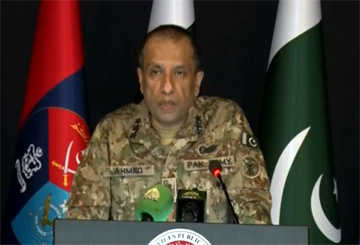
RAWALPINDI: Eleven Pakistan Army personnel, including a Junior Commissioned Officer (JCO), embraced martyrdom after terrorists attacked a military convoy in Balochistan’s Bela district, while security forces killed 40 militants in multiple counterterrorism operations across the province, Director General of Inter-Services Public Relations (DG ISPR) Lieutenant General Ahmed Sharif Chaudhry said on Wednesday.
During a detailed press briefing, the military spokesperson outlined the security situation in Balochistan, highlighting recent terrorist attacks, ongoing military operations, and Pakistan’s assessment of cross-border terrorism.
Army Convoy Attacked on N-25 Highway
According to the DG ISPR, the attack occurred in the Bela-Winder area along the strategic N-25 Highway when terrorists targeted a Pakistan Army convoy.
The assault resulted in the martyrdom of one Junior Commissioned Officer and ten soldiers. Lt Gen Chaudhry paid tribute to the fallen personnel, describing their sacrifice as a testament to the armed forces’ unwavering commitment to defending Pakistan against terrorism.
Security Forces Eliminate 14 Militants in Kharan and Dalbandin
Following the attack, security forces launched intelligence-based operations in different parts of Balochistan.
Lt Gen Chaudhry said six militants were killed during an operation in Kharan, while another eight were neutralized in Dalbandin. He added that the operations formed part of Pakistan’s ongoing campaign to dismantle terrorist networks operating in the province.
Three Major Terrorist Incidents in Four Days
The DG ISPR said Pakistan witnessed three significant terrorist incidents over the past four days.
The first incident occurred on the night between July 4 and July 5 in Hanna Urak, where militants belonging to what the state refers to as Fitna-ul-Khawarij attacked local residents.
According to Lt Gen Chaudhry, the local population courageously resisted the assault, forcing the attackers to retreat. Four civilians were martyred and six others sustained injuries during the attack.
He alleged that Fitna-ul-Khawarij, the state’s term for the banned Tehreek-e-Taliban Pakistan (TTP), was acting as an Indian proxy.
Mangi Dam Police Checkpost Came Under Multi-Directional Attack
The military spokesperson said the second major attack targeted a police checkpost near Pumping Station No. 3 of Mangi Dam in Ziarat district.
He explained that the facility protects critical infrastructure supplying water to Quetta, with police personnel deployed around the clock to secure the pumping station and water pipeline.
“Terrorists launched a coordinated multi-directional attack on the checkpoint,” Lt Gen Chaudhry said.
He praised the police officers for putting up fierce resistance despite being heavily outnumbered.
27 Police Personnel Martyred, 26 Militants Killed
According to the DG ISPR, nine police personnel were martyred during the initial assault, while another 18 embraced martyrdom during the subsequent security operation, taking the total number of police martyrs to 27.
Security forces initially killed 15 militants during the battle. As follow-up operations continued in the surrounding mountainous terrain, another 11 militants were eliminated, bringing the total number of militants killed in the Ziarat engagements to 26.
Lt Gen Chaudhry said operations remain underway and indicated that the actual militant death toll could be higher.
He also noted that the military deliberately refrained from employing aerial assets during the operation to avoid collateral damage, as police personnel remained engaged in close combat with the attackers.
India and Afghan Territory Used to Support Terrorism, DG ISPR Alleges
Addressing the broader security situation, Lt Gen Chaudhry alleged that India, in collaboration with hostile elements, was supporting terrorist activities inside Pakistan.
He further claimed that militant groups were using territory under the control of the Afghan Taliban as operational bases and alleged that many militants killed during recent engagements were Afghan nationals.
Referring to the recent terrorist attack on a Rangers camp in Karachi, the DG ISPR said three of the four attackers were Afghan citizens and alleged that the planning, logistics, training, and equipping of the attackers had taken place inside Afghanistan.
He further alleged that recent terrorist incidents in Balochistan reflected coordinated planning, external facilitation, logistical support, and organized operational execution.
Pakistan Vows Relentless Action Against Terrorists
The DG ISPR said Pakistan’s armed forces, under the leadership of Chief of Army Staff and Chief of Defence Staff Field Marshal Asim Munir, have a clear understanding of the evolving terrorist threat and are operating under the strategic guidance of the government.
He vowed that security forces would continue pursuing terrorists, their facilitators, financiers, planners, and those providing them sanctuary, wherever they may be.
“We will take on every terrorist, every facilitator, everyone who shelters or supports them, without any distinction,” he said.
UN Security Council Reports Rising Terror Threat
The DG ISPR’s briefing comes amid growing concerns over rising terrorist violence in Pakistan, particularly in Balochistan and Khyber Pakhtunkhwa.
Earlier reports by the United Nations Security Council (UNSC) also highlighted an increase in attacks by the banned Baloch Liberation Army (BLA) against Pakistani security forces and projects linked to the China-Pakistan Economic Corridor (CPEC).
According to the UN reports, some member states assessed that the BLA, Tehreek-e-Taliban Pakistan (TTP), and Islamic State Khorasan Province (ISKP) have shared training facilities, resources, and operational coordination in certain attacks.
The reports further stated that terrorist groups operating from Afghanistan have gained access to sophisticated weaponry, including advanced assault rifles, thermal imaging systems, night-vision devices, sniper weapons, and drone technology, raising concerns about the increasing capability of militant organizations operating in the region.
