

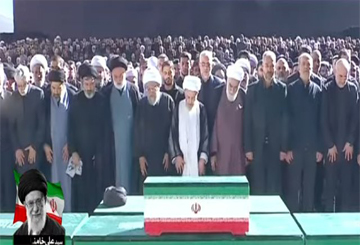
Funeral prayers offered for Iran’s martyred Supreme leader Ayatollah Ali Khamenei
Funeral prayers offered in Tehran before planned burial arrangements: Thousands of mourners gather across the Iranian capital: Final burial to take place in Mashhad Body of Ayatollah Ali Khamenei would be taken to Najaf and Karbala
Funeral prayers for Iran’s martyred Supreme Leader, Ayatollah Ali Khamenei, were held in Tehran on Sunday morning, attracting an enormous gathering of mourners from across the country. Thousands of people assembled at the Grand Mosalla complex and lined the major streets of the Iranian capital to pay their final respects to the late leader, reflecting the significance of the occasion and the deep emotions surrounding his death.
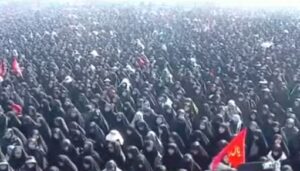
According to Iranian media reports, the funeral ceremony witnessed one of the largest public gatherings in recent years. Men, women, elderly citizens, and young people traveled from different provinces to participate in the mourning events. Many carried Iranian flags, black banners, and red flags symbolizing sacrifice, vengeance, and justice. Participants chanted religious slogans as well as political messages expressing solidarity with the Islamic Republic.

State media reported that the bodies of Ayatollah Khamenei and several deceased members of his family had been placed in Tehran for public viewing ahead of the official funeral prayers. Thousands of mourners reportedly visited the venue throughout the day to offer condolences, recite prayers, and bid farewell. The atmosphere was marked by grief, with many participants openly expressing sorrow over the passing of the country’s long-serving leader.
Authorities announced that Sunday had been declared a nationwide public holiday to allow citizens to participate in the funeral ceremonies. Following the funeral prayers, Khamenei’s body was scheduled to remain at the Grand Mosalla complex before being taken through Tehran in a large public procession on Monday. Officials expected millions of people to participate in the procession, describing it as one of the largest funeral gatherings in Iran’s modern history.
Iranian media further reported that the funeral procession would continue beyond the capital. According to the planned arrangements, the body would first be transported to the religious city of Qom before being taken to the Iraqi holy cities of Najaf and Karbala, two of the most sacred destinations in Shia Islam. Following these visits, the final burial ceremony was scheduled to take place in Mashhad, Iran’s northeastern holy city and Khamenei’s hometown.
International news agency AFP reported that special funeral prayers were expected to be offered over Khamenei’s casket on Sunday morning. However, authorities had not officially confirmed whether the prayers would be led by a senior religious scholar or by a member of the late leader’s family. The reports stated that Khamenei had served as Iran’s Supreme Leader since 1989 and was killed at the age of 86 during an airstrike on the first day of the Middle East conflict on February 28.
Reports also claimed that his son and designated successor, Mojtaba Khamenei, had not appeared publicly since being appointed as Iran’s new Supreme Leader. According to the same reports, he was believed to have sustained injuries during the attack that allegedly claimed his father’s life.
Hassan Hassanzadeh, the commander of the Revolutionary Guards in Tehran responsible for organizing the funeral ceremonies, announced that official prayers over the late leader’s body would begin at 8:00 a.m. local time. State television broadcast extensive coverage of the preparations, highlighting the participation of military officials, religious scholars, government representatives, and ordinary citizens.
The public mourning ceremonies had begun on Saturday, when vast crowds gathered at the Grand Mosalla complex. Many mourners dressed in black as a symbol of grief, while others waved blood-red flags associated with sacrifice and calls for justice. Emotional scenes were witnessed throughout the ceremony as participants beat their chests in traditional mourning rituals and chanted slogans including “Death to America” and “Revenge, revenge.”
Among the mourners was cleric Mohammad Mirsalehi, who described Ayatollah Khamenei as a father figure for the Iranian nation. Speaking during the ceremony, he said that the leader’s passing had left the country feeling orphaned and that his legacy would continue to inspire future generations.
Photographs released during the ceremony reportedly showed Khamenei’s coffin, draped with symbolic coverings and topped with his traditional black turban, placed prominently at the front of the funeral hall. Nearby were the coffins of four members of his family who were also reported to have died in the February 28 strikes, including his infant granddaughter.
Iranian authorities estimated that the funeral ceremonies could attract more than ten million participants in Tehran alone, making the event one of the largest public gatherings in the country’s history.
The funeral also drew the attention of regional and international observers. It came at a time when fighting in the Middle East had paused following a ceasefire and an initial agreement involving the United States. Despite the temporary halt in hostilities, both Tehran and Washington reportedly warned that military action could resume if tensions escalated.
Political analysts viewed the funeral as a major test of public support for Iran’s government following widespread protests earlier in the year. During a speech at the ceremony, President Masoud Pezeshkian praised the large public turnout, describing it as evidence of Khamenei’s influence among the Iranian people. He accused Israel of contributing to instability across the Middle East and declared that Muslims would continue resisting oppression and foreign pressure.
Throughout his decades in power, Khamenei had pursued a confrontational policy toward Western countries and strongly supported regional groups opposed to the United States and Israel, including Hamas in Palestine and Hezbollah in Lebanon.
State media reported that foreign delegations attending the funeral included representatives from Hezbollah, Hamas, Yemen’s Houthi movement, and Palestinian Islamic Jihad. These delegations also met with Foreign Minister Abbas Araghchi during their visit to Tehran.
According to the official schedule, the funeral procession was expected to continue over several days. After Monday’s events in Tehran, the coffin would travel to Qom on Tuesday, then to Iraq on Wednesday for visits to the holy cities of Najaf and Karbala, before returning to Iran for the final burial in Mashhad on Thursday.
Authorities implemented extensive security measures across Tehran to manage the expected crowds and prevent overcrowding. Official media also warned mourners about the possibility of crowd congestion and urged them to follow safety instructions. In addition, organizers introduced measures to cope with a severe heatwave expected to push temperatures close to 40 degrees Celsius, including water misting systems and cooling stations at major gathering points.
