

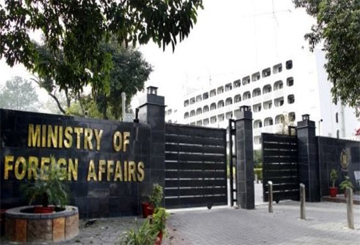
FO cautions UK diaspora over interference in Pakistan and AJK affairs amid unrest
Pakistan’s Foreign Office strongly rejected comments made by some members of the Kashmiri and Pakistani diaspora in the United Kingdom regarding the ongoing unrest in Azad Jammu and Kashmir (AJK). In an official statement issued on Monday, the Foreign Office described the remarks as “irresponsible and ill-informed insinuations” and warned overseas groups against interfering in Pakistan’s internal matters.
The controversy emerged after violent clashes took place in Rawalakot, a city in AJK, where the recently banned Joint Awami Action Committee (JAAC) had organised a sit-in protest outside the Combined Military Hospital (CMH). According to AJK police, armed members of the JAAC launched a planned attack on security personnel stationed at the site. Authorities claimed that the protesters opened fire on law enforcement officers, resulting in the deaths of four security officials and injuries to nearly 20 others.
However, the JAAC rejected the government’s version of events. The organisation claimed that security forces initiated the violence by firing tear gas shells toward the hospital and using live ammunition against protesters. In a statement posted on social media platform X, JAAC alleged that electricity in the area was deliberately cut off before indiscriminate firing began in the darkness. The group claimed that seven civilians were killed and dozens were injured during the operation.
The unrest in AJK also drew international attention. The All-Party Parliamentary Group on Kashmir in the British Parliament wrote a letter to the UK Foreign Secretary, signed by 31 lawmakers, expressing concern over the situation and urging diplomatic intervention. At the same time, several overseas Pakistanis and Kashmiris publicly criticised the actions of the AJK government and security agencies.
Responding sharply, Pakistan’s Ministry of Foreign Affairs advised members of the diaspora to avoid interfering in the affairs of Pakistan and AJK. The ministry said such individuals should instead focus on contributing positively to the societies in which they currently live. The statement further criticised certain British Members of Parliament for making what it described as “unwarranted remarks,” accusing them of lacking awareness about the historical and constitutional background of the Kashmir issue.
The Foreign Office also issued a strong message regarding Pakistan’s sovereignty. It stated that Pakistan is an independent democratic republic that believes in non-interference in the affairs of other nations and expects the same principle to be respected by foreign governments and lawmakers.
While defending the state’s actions, the Foreign Office said the governments of Pakistan and AJK fully recognise the constitutional rights of citizens, including the right to peaceful protest, freedom of expression, and democratic participation. However, it stressed that violence, destruction of public property, attacks on hospitals, and the killing of civilians or law enforcement personnel could not be tolerated under any circumstances.
The ministry also called upon the British government to caution individuals supporting banned organisations and to encourage respect for democratic institutions, judicial decisions, and the rule of law under the constitutions of Pakistan and AJK.
The latest violence has intensified political tensions in AJK ahead of upcoming elections scheduled for July 27. The issue of refugee representation in the AJK Legislative Assembly remains one of the central causes of unrest. The 53-member assembly includes 12 seats reserved for refugees who migrated from Indian-controlled Kashmir during the wars of 1947 and 1965. Six seats are allocated to refugees from the Jammu region, which has a much larger refugee population, while six seats are reserved for refugees from the Kashmir Valley, despite their significantly smaller population. Critics argue that this arrangement is unequal and politically outdated.
The JAAC has emerged as one of the strongest voices demanding reforms in AJK. During widespread protests last year, the group called for constitutional and governance changes, including the abolition of the 12 refugee seats, the end of privileges enjoyed by political elites, and reforms to the quota system. Those protests turned deadly in October, when clashes between demonstrators and police left at least nine people dead, including three policemen.
After the violence, negotiations between the government and the JAAC resulted in an agreement covering several major demands. Both sides agreed to establish a high-level committee to examine the refugee seat issue. Despite this, the matter remains unresolved, leading to renewed protests and political instability.
The unrest also caused major political changes within AJK. Following the protests, the Pakistan Peoples Party (PPP), supported by the Pakistan Muslim League-Nawaz (PML-N), moved a no-confidence motion against then-prime minister Chaudhry Anwarul Haq. Although Haq initially chose to face the vote, Raja Faisal Mumtaz Rathore was eventually elected as the 16th Prime Minister of AJK on November 17 after securing 36 votes.
As elections approach once again, the AJK government organised an All Parties Conference (APC) in Muzaffarabad to build political consensus on the refugee seat issue. Most major political parties attended the meeting, but both the Pakistan Tehreek-e-Insaf (PTI) and the JAAC boycotted it.
The JAAC argued that participation in the APC would be meaningless because the government had already rejected its written reform proposals submitted earlier this year. The organisation proposed either limiting refugee representation to a symbolic level until the Kashmir dispute is permanently resolved or replacing the 12 assembly seats with four seats in the AJK Council, which is chaired by Pakistan’s Prime Minister. According to the JAAC, this approach would preserve the political identity of the Kashmir issue while addressing concerns about democratic fairness.
The APC ultimately rejected any changes outside the existing constitutional framework, stating that only the elected legislative assembly had the authority to amend refugee seat arrangements. In response, the JAAC dismissed the APC’s conclusions as meaningless and accused political leaders of prioritising personal interests over public concerns.
The organisation has now announced a large protest march in Muzaffarabad on June 9, calling for supporters from across AJK to participate. Meanwhile, Minister for Parliamentary Affairs Dr Tariq Fazal Chaudhry defended the government’s position, saying that most commitments made to the JAAC had already been fulfilled. He warned against attempts to create instability in AJK and emphasised that dialogue, not violence, was the only acceptable solution to political disagreements.
The ongoing tensions highlight the deep political divisions in AJK and the growing debate over governance, representation, and constitutional reforms. With elections drawing near and public anger continuing to rise, the situation remains highly sensitive and politically significant for both AJK and Pakistan.
