


EU Calls Pakistan a Major Regional Power in Deepening Strategic Ties
In a significant diplomatic development underscoring shifting global alignments, the European Union has described Pakistan as a “major regional power” and an “important partner,” signaling a deeper and more comprehensive phase of engagement that extends well beyond trade into geopolitics, climate cooperation, energy transition, and conflict diplomacy.
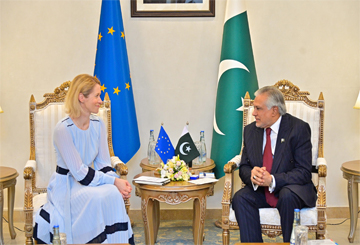
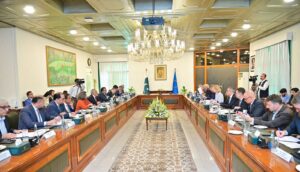
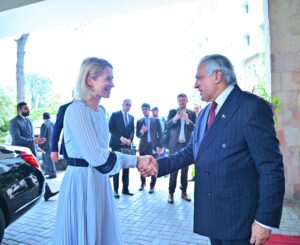
The remarks were made by EU foreign policy chief Kaja Kallas during the 8th EU–Pakistan Strategic Dialogue held in Islamabad. She met Pakistan’s Deputy Prime Minister and Foreign Minister Ishaq Dar, with both sides reaffirming their commitment to strengthening long-term strategic cooperation amid rising global uncertainty.
Kallas said EU–Pakistan relations are entering a more dynamic and multidimensional phase, with cooperation expanding far beyond traditional trade relations. She highlighted key areas of growing collaboration including climate resilience, clean energy development, digital infrastructure, migration governance, mobility frameworks, and people-to-people exchanges. According to her, these areas are now central to shaping a future-oriented partnership between the two sides.
A major highlight of the discussions was Pakistan’s involvement in facilitating diplomatic engagement between the United States and Iran. Kallas praised Islamabad’s role in supporting dialogue between the two sides, describing it as an important contribution toward reducing tensions in a conflict that carries significant global consequences, particularly for energy stability and fertilizer prices. She emphasized the need for continued negotiations, maintenance of ceasefire efforts, and sustained diplomatic communication to prevent further escalation.
She noted that the global environment is increasingly defined by geopolitical tensions and risks of conflict escalation, making international cooperation and restraint essential. Kallas said Pakistan is operating in a highly contested regional landscape and stressed that stability in such environments is crucial for broader global security and economic balance.
The EU foreign policy chief also addressed recent tensions between Pakistan and Afghanistan, calling on both countries to exercise restraint and pursue de-escalation. She warned that renewed clashes could have severe humanitarian consequences and risk further destabilizing the region, including fueling radicalization. While acknowledging Pakistan’s right to defend itself under international law, she stressed that dialogue and peaceful resolution remain the preferred path forward.
On Pakistan’s side, Ishaq Dar reiterated Islamabad’s commitment to achieving a “comprehensive and lasting solution” to the US–Iran conflict. He also highlighted ongoing communication with EU counterparts on key regional issues, including past tensions with India and the evolving security situation in Afghanistan. Dar said Pakistan continues to play an active diplomatic role aimed at reducing tensions and promoting regional stability.
The European Union remains Pakistan’s second-largest trading partner, with economic ties anchored in the Generalised Scheme of Preferences Plus (GSP+) framework, which provides Pakistan preferential access to European markets through reduced or zero tariffs on a wide range of exports. This trade arrangement continues to serve as a strong economic foundation for an increasingly broad and strategic partnership.
The latest EU–Pakistan dialogue reflects a clear transition toward a more comprehensive relationship that integrates trade, diplomacy, climate cooperation, and regional security engagement, as both sides seek closer alignment in an increasingly complex global environment.
The latest EU–Pakistan Strategic Dialogue reflects a clear shift in bilateral relations from a largely trade-focused framework to a broader strategic partnership shaped by global diplomacy, regional stability, and shared economic interests. By acknowledging Pakistan as a “major regional power,” the European Union has signaled greater confidence in Islamabad’s role in regional and international affairs, particularly in conflict mediation and diplomatic engagement.
At a time of rising geopolitical tensions and economic uncertainty, both sides appear aligned on expanding cooperation in critical areas such as climate resilience, clean energy, digital development, migration management, and regional security. The discussions also highlighted Pakistan’s growing relevance in facilitating dialogue between key global actors, reinforcing its position as an active diplomatic stakeholder.
With strong trade ties under the GSP+ framework and increasing political engagement, EU–Pakistan relations are steadily evolving into a more comprehensive and forward-looking partnership, aimed at addressing shared challenges and promoting stability in an increasingly complex global order.
