

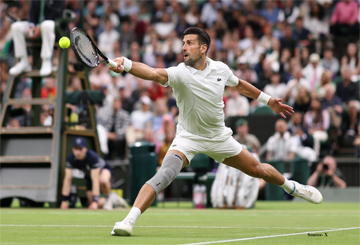
Djokovic urges schedule changes as heatwave intensifies at French Open
Novak Djokovic has taken another step toward a historic 25th Grand Slam title at the French Open after defeating France’s Valentin Royer in a demanding four-set encounter on Wednesday. However, the Serbian legend also raised concerns about the extreme heat conditions at Roland Garros, suggesting that match schedules should be adjusted to avoid the hottest hours of the day.
Playing under a scorching sun on Court Philippe Chatrier, Djokovic overcame the world number 74 6-3, 6-2, 6-7 (7/9), 6-3 to secure his place in the third round. The match lasted close to three hours and tested both players physically due to temperatures rising into the mid-30s Celsius in Paris.
Despite taking a comfortable two-set lead and appearing in control early on, Djokovic was pushed hard by the home favourite. Royer, who grew up just a few kilometres from the Roland Garros complex, energized the French crowd by mounting a strong comeback in the third set. He twice broke back to level the score and later stunned spectators by recovering from 3-0 down in the tie-break to claim the set 7-6, forcing a fourth set and extending the contest.
As the match wore on, Djokovic appeared to struggle with the intense heat and physical demands. Royer capitalized on the momentum shift and forced the veteran to dig deep. However, experience ultimately prevailed. Early in the fourth set, Djokovic produced a moment of brilliance with a stretching forehand winner from wide beyond the net post, which proved to be a turning point. He immediately broke serve to go 3-1 up and regained full control, eventually closing out the match with his trademark composure.
After the match, Djokovic acknowledged both the difficulty of the conditions and the effort of his opponent. He praised Royer’s performance and admitted that playing in such heat makes matches significantly more challenging.
Speaking to reporters, the 24-time Grand Slam champion also suggested that tournament organizers consider rescheduling matches during extreme weather conditions. He argued that Grand Slam events have enough courts and facilities, including stadiums with floodlights, to allow matches to be played later in the evening when temperatures are cooler. He referenced tournaments such as Umag in Croatia, where matches often begin later in the day and continue into the night, as an example of how scheduling could be adapted—though he also acknowledged that finishing matches after midnight is not ideal.
Djokovic emphasized that while late finishes are not perfect, player safety and performance quality should take priority during heatwaves. He noted that rescheduling could be a practical solution without disrupting crowd attendance or tournament logistics.
Looking ahead, Djokovic will face a new challenge in the third round against 19-year-old Brazilian rising star João Fonseca. The matchup is particularly notable as Fonseca was born more than a year after Djokovic made his debut at Roland Garros, highlighting the generational gap between the two players.
Fonseca enters the contest with growing attention on him after an impressive five-set victory over Croatia’s Dino Prižmić. In that match, the young Brazilian displayed resilience by coming back from two sets down to win 3-6, 4-6, 6-3, 6-1, 6-2, earning strong support from his passionate fanbase. His victory also carries added narrative weight, as Prižmić had previously defeated Djokovic at the Italian Open earlier in May.
Djokovic praised Fonseca’s talent and composure, calling him a “big-stage player” with clear potential and noting the strong backing he receives from Brazilian fans at tournaments around the world. He acknowledged that Fonseca thrives under pressure and enjoys the atmosphere of major matches.
The upcoming third-round clash will mark the first-ever meeting between the seasoned 24-time Grand Slam champion and the emerging teenage talent, setting up an intriguing generational battle on the French Open stage.
