

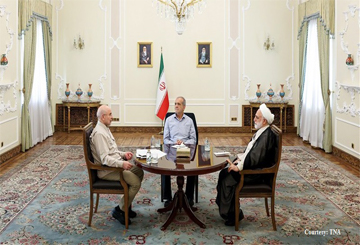
One God, one nation, one leader, one path; victory for Iran, dearer than life: Iran Leadership’s message to Trump
TEHRAN: Iran’s top leadership has issued a unified and forceful response to remarks made by former U.S. President Donald Trump, rejecting his claims about internal political divisions within Iran and describing them as false, provocative, and politically motivated.
The coordinated reaction came from the country’s three highest authorities: President Masoud Pezeshkian, Speaker of Parliament Mohammad Baqer Qalibaf, and Judiciary Chief Gholamhossein Mohseni Ejei. All three leaders used social media on Thursday to deliver a consistent message emphasizing national unity and rejecting any suggestion that Iran is divided into “moderates” and “extremists.”
Strong message of unity from Iranian leaders
President Pezeshkian firmly dismissed Trump’s characterization of Iran’s political structure, arguing that such labels have no relevance within the country’s political identity. He stressed that Iranians do not define themselves through Western political categories.
According to Pezeshkian, all Iranians share a unified national and ideological identity. He stated that citizens and officials alike see themselves as “Iranians” and “revolutionaries,” highlighting solidarity between the government and the people.
He further emphasized unity between the state and the leadership system, writing that Iran stands firmly together under the authority of its leadership. He added that this unity would ultimately force any aggressor to regret hostile actions against the country.
In a strongly worded conclusion, he described Iran’s unity as absolute, declaring that the nation follows “one God, one nation, one leader, one path,” and expressed confidence in Iran’s eventual success.
Parliament and judiciary echo the same position
Parliament Speaker Mohammad Baqer Qalibaf issued a statement aligned closely with the president’s remarks. His message reinforced the idea that Iran’s political institutions are united in rejecting foreign interpretations of internal divisions. His statement was seen as part of a coordinated effort among Iran’s top branches of government to present a single, unified position.
Judiciary Chief Gholamhossein Mohseni Ejei adopted an even more critical tone. He dismissed terms like “moderate” and “hardliner” as artificial labels created within Western political discourse, arguing that they do not reflect Iran’s reality.
He emphasized that all political and institutional groups in Iran stand in full alignment with the country’s leadership, rejecting any suggestion of internal fragmentation. His comments were notably sharp in tone, directly challenging the credibility of the U.S. president’s statements.
Background to the dispute
The Iranian response followed Trump’s recent comments announcing an extension of a ceasefire related to conflict involving Iran. In his remarks, Trump suggested that the decision was influenced in part by what he described as internal fractures within the Iranian government.
These comments were reported by Iranian media as portraying Iran as politically unstable, a characterization that Tehran strongly rejected.
Escalation of tensions and past conflict
The exchange comes against a backdrop of heightened tensions between Iran and the United States, along with Israel. According to reports cited by Iranian media, a large-scale military confrontation began on February 28, during which Iran claims its leadership and senior military commanders were targeted.
In response, Iranian Armed Forces reportedly carried out extended missile and drone operations against U.S. and Israeli military positions over a period of more than 40 days, causing significant damage.
Later, a temporary two-week ceasefire was reached on April 8. This was followed by negotiations held in Islamabad, where Iranian officials presented a ten-point proposal that included demands for the withdrawal of U.S. forces from the region and the lifting of economic sanctions.
However, despite lengthy discussions lasting over 20 hours, the talks ended without a breakthrough. Iranian representatives stated that the negotiations failed due to a lack of trust in U.S. commitments.
