

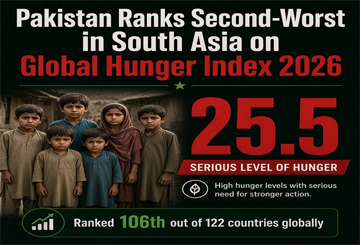
Pakistan Ranks Second-Worst in South Asia on Global Hunger Index 2026, Score Reaches 25.5
33.6% of children under five suffer from stunting, while 16.1% of the population faces undernourishment, highlighting persistent food security and nutrition challenges
ISLAMABAD: (Web Desk) Pakistan has ranked second-worst in South Asia on the Global Hunger Index (GHI) 2026, with a score of 25.5, underscoring persistent challenges related to food insecurity, undernutrition and child malnutrition, according to the latest report published on the index’s official website.
The report categorises Pakistan’s level of hunger as “serious”, placing it behind only Afghanistan among countries in South Asia. Afghanistan recorded a score of 28.6, while the regional average stood at 23.5. The global Global Hunger Index score was 18.1, reflecting the continuing burden of hunger and malnutrition in vulnerable populations around the world.
Despite its position in the regional rankings, Pakistan has recorded a significant long-term improvement in its hunger score. According to the report, the country’s GHI score declined from 36.2 in 2000 to 25.5 in 2026, indicating progress over the past two and a half decades. However, the latest figures suggest that substantial challenges remain in ensuring adequate nutrition and improving health outcomes, particularly among children.
Pakistan ranked 106th out of 122 countries for which sufficient data were available to calculate the 2026 index scores. The ranking highlights the scale of the country’s continuing nutrition challenges compared with other countries included in the assessment.
Child malnutrition remains a major concern
The report identifies undernourishment and child malnutrition as key indicators of Pakistan’s hunger situation. It estimates that 16.1 per cent of the country’s population is undernourished, meaning that a significant proportion of people do not receive sufficient dietary energy to meet their basic nutritional requirements.
The findings also reveal a substantial burden of chronic malnutrition among young children. According to the report, 33.6 per cent of children under the age of five in Pakistan suffer from stunting, a condition in which children have a low height for their age.
Child stunting is widely used as an indicator of chronic undernutrition and can reflect prolonged nutritional deficiencies, recurrent illness and other adverse conditions affecting children’s growth and development. Its prevalence points to persistent difficulties in ensuring that young children receive adequate nutrition during the critical early years of life.
The consequences of malnutrition can extend beyond physical growth, affecting children’s health, cognitive development and ability to learn. Persistent undernutrition during early childhood can also have long-term implications for educational attainment, productivity and overall human development.
How the Global Hunger Index measures hunger
The Global Hunger Index assesses hunger through four key indicators: undernourishment, child stunting, child wasting and child mortality. These indicators collectively measure different dimensions of inadequate food intake and its consequences for children’s health and survival.
Undernourishment measures the proportion of the population whose calorie intake is insufficient to meet their minimum dietary energy requirements. It provides an indication of the prevalence of inadequate access to food at the population level.
Child stunting measures the percentage of children under five whose height is low for their age. It is associated with chronic undernutrition and reflects the cumulative effects of nutritional deficiencies and other health-related factors over time.
Child wasting measures the proportion of children under five whose weight is low relative to their height. It is generally associated with acute undernutrition and may result from insufficient food intake, illness or a combination of both.
The fourth indicator, child mortality, measures the proportion of children who die before reaching their fifth birthday. Although child deaths can result from various causes, undernutrition can increase children’s vulnerability to disease and raise the risk of mortality.
By combining these four indicators, the index provides a broader assessment of hunger than food availability alone, taking into account both inadequate dietary intake and its effects on child growth and survival.
Long-term improvement, but challenges persist
Pakistan’s decline in its GHI score from 36.2 in 2000 to 25.5 in 2026 represents a notable improvement over the period covered by the report. Nevertheless, its classification as a country facing a serious level of hunger indicates that progress has not been sufficient to eliminate widespread nutritional deprivation.
The latest figures place food security and child nutrition among the country’s continuing development challenges. The high prevalence of stunting, in particular, highlights the importance of improving access to nutritious food and addressing the broader conditions that affect maternal and child health.
The report’s findings also underline the distinction between long-term progress and the persistence of serious problems. While Pakistan has improved its overall index score over time, the latest assessment indicates that millions of people may still face difficulties in obtaining adequate nutrition, with young children particularly vulnerable to the consequences of undernutrition.
Pakistan’s position in the 2026 Global Hunger Index therefore highlights the need for sustained efforts to improve food security, strengthen nutrition outcomes and reduce child malnutrition. The figures show that, despite measurable improvement since 2000, hunger and undernutrition remain significant challenges for the country.
