

K-P Vows All-Out War on Terrorism as Kundi, Naqvi Call for Unity
Governor, interior minister stress coordinated action, stronger police and CTD capabilities after imposition of governor’s rule
Interior Minister says federal and provincial governments are “on the same page” after governor’s rule; authorities call for stronger police, CTD support and a phased security plan
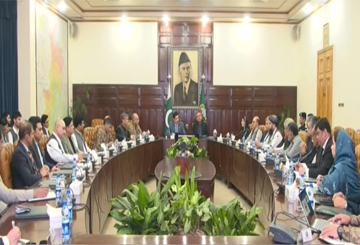
PESHAWAR: Khyber-Pakhtunkhwa Governor Faisal Karim Kundi and Interior Minister Mohsin Naqvi on Monday called for coordinated and result-oriented action against terrorism, as the province’s first Apex Committee meeting was held following the imposition of emergency measures and governor’s rule.
Addressing the meeting, Kundi said eliminating terrorism was the province’s foremost priority and stressed that security could not be compromised for the sake of development. He called for stronger coordination between the federal and provincial administrations and adequate resources for law-enforcement agencies to counter the growing security challenges.
“There are many other issues, but our first priority is to eliminate terrorism. We can sacrifice development, but we cannot compromise on security,” the governor said.
Kundi emphasised that the police and the Counter-Terrorism Department (CTD) must be provided with the equipment, facilities and operational support required to confront terrorist threats. Describing law-enforcement personnel as the frontline force in the fight against terrorism, he said their legitimate demands must be met to enable them to perform their duties effectively.
“We have to fulfil their demands because they are our frontline force,” he said.
The governor urged the authorities to move beyond symbolic measures and focus on actions that produced tangible improvements in the security situation. He said the government should concentrate on a smaller number of practical initiatives if they could deliver visible and measurable results.
“We should focus on result-oriented measures, not cosmetic steps to show that we are working for peace,” Kundi said, adding that the people of K-P wanted peace, development and prosperity.
He observed that persistent insecurity had restricted people’s ability to travel freely, conduct business and pursue their daily activities without fear. The government, he said, needed to establish conditions in the province similar to those enjoyed by people in more peaceful parts of the country.
Kundi also linked the restoration of peace with economic recovery, saying improved security would help attract investment and unlock the province’s considerable economic potential, including its natural resources, agricultural production, energy prospects and tourism sector.
He stressed that federal and provincial institutions must work in close coordination to address security gaps and ensure that decisions were implemented effectively.
“There should be no situation in which we are not on the same page,” he said, reiterating that the government would continue using the relevant forums and committees to improve coordination.
Naqvi says Centre, province finally on same page
Interior Minister Mohsin Naqvi said the meeting marked a significant step towards coordinated counterterrorism efforts, claiming that, for the first time in two-and-a-half years, he could confidently say that the federal and provincial governments were working on the same page
He paid tribute to security personnel who had continued fighting terrorism under difficult circumstances, saying the burden of the conflict had fallen heavily on those confronting militants on the ground
“The hardest task was faced by the people who were fighting this war. There were times when people would not even attend the funerals of those who had been martyred,” Naqvi said
The interior minister praised security personnel who, according to him, had fought terrorists without receiving the necessary support from the government. He maintained that an effective counterterrorism campaign required political and administrative leadership alongside the efforts of the armed forces and police
“No matter how many resources you provide, a war cannot be won unless the government there leads it,” he said.
Naqvi said the federal government had repeatedly sought cooperation from the provincial administration over the preceding two-and-a-half years, but the level of coordination required for an effective response had not materialised.
He argued that the people and security personnel remained the same, but stronger government leadership and institutional cooperation could improve the results of counterterrorism operations.
The minister cautioned that the security situation would not change overnight and that difficult challenges could lie ahead. However, he assured the people of K-P that the governor, police, provincial advisers and federal government would work together to address them.
“If we stand together, there is no way they can defeat us,” he added.
Five-district security plan to be revived
Naqvi also called for the revival of a five-district security plan under which police and other relevant institutions would receive additional assistance in phases.
He stressed that law-enforcement personnel could not be expected to confront heavily armed militants effectively without modern weapons, equipment and adequate facilities.
“If you cannot provide protection or facilities to a police officer, and your opponent has modern weapons while the officer has only a pistol, how can you expect that officer to fight effectively?” he asked.
The interior minister welcomed initiatives being undertaken by the relevant security authorities to strengthen the police, expressing hope that the proposed measures would mark an important step towards improving the force’s operational capacity.
He also commended the public for remaining peaceful during the preceding 24 hours, saying authorities had been concerned that protests could disrupt normal life across the province.
“The province is largely peaceful, and the people want peace. Their expectations are clear; now it is up to us to deliver,” Naqvi said.
He urged the new administrative setup and security institutions to maintain close coordination, saying sustained efforts and a unified approach would be essential to achieving lasting peace.
Federal government imposes emergency, governor’s rule
The Apex Committee meeting followed the federal government’s decision on Sunday to impose emergency measures and governor’s rule in K-P after the federal cabinet approved the move and Prime Minister Shehbaz Sharif advised President Asif Ali Zardari to invoke Articles 232 and 234 of the Constitution. The president signed the summary, transferring executive authority from the provincial government to Governor Faisal Karim Kundi under the announced arrangement.
The federal government cited an escalation in terrorist attacks, threats to lives and property, attacks on government installations and law-enforcement personnel, and what it described as the provincial government’s failure to take adequate measures to address terrorism.
Article 232 provides for the proclamation of an emergency in circumstances specified by the Constitution, including war, external aggression or internal disturbance beyond the control of a provincial government. Article 234 provides for intervention when a province’s constitutional machinery cannot be carried on in accordance with the Constitution.
According to the proclamation, Articles 232(1) and 234(1) were invoked on the grounds that the provincial government could not function constitutionally under the prevailing circumstances. The arrangement provides for the governor to assume some or all functions of the provincial government, while the powers of the provincial assembly are to be exercised by Parliament or under its authority, as specified in the applicable constitutional framework.
The chief minister, provincial ministers, advisers, special assistants and advocate general ceased to hold office with immediate effect under the announced arrangement.
The emergency measures were declared in 12 districts rather than across the entire province. These comprise the eight merged tribal districts — Bajaur, Mohmand, Khyber, Kurram, Orakzai, North Waziristan, South Waziristan Upper and South Waziristan Lower — as well as Dera Ismail Khan, Tank, Bannu and Lakki Marwat.
The designated area covers the Bannu and Dera Ismail Khan divisions in full and parts of the Peshawar, Kohat and Malakand divisions. Hazara and Mardan divisions were excluded from the specified districts.
The federal government also authorised the deployment of Pakistan Army troops and assets under Article 245 to assist the civil administration and help protect citizens, public and private property, and government installations.
Eleven-member advisory council formed
To assist Kundi in administering the province under the new arrangement, the federal government constituted an 11-member advisory council comprising Tariq Mahmood Pasha, Dr Aamir Abdullah, retired Lieutenant General Nigar Johar, Samar Bilour, Dr Sarfaraz Ali, Aamir Javed, Dr M Irshad, Kifayatullah, Tayyab Qureshi, Usman Saifullah Khan and Asif Rafiq.
Sanaullah Advocate was appointed provincial advocate general. The advisory council is intended to support the governor in overseeing provincial administrative affairs.
The federal government also ordered the establishment of an Area Development Secretariat to supervise administration, security, law enforcement and development activities in the 12 designated districts.
The secretariat is to operate under an Area Representative and Development Council, with the additional chief secretary for the designated districts also serving as their administrator.
Under the order, the administrator can issue directions to civil administration, police and military authorities, supervise relevant departments and order the allocation or transfer of funds. Provincial officers and personnel serving in the designated districts have also been placed under the secretariat’s administrative and operational control.
With terrorism remaining the central challenge confronting the province, Monday’s Apex Committee meeting placed renewed emphasis on strengthening law enforcement, improving intergovernmental coordination and ensuring that security measures translated into tangible results. The effectiveness of the new administrative arrangement will ultimately depend on its implementation, the resources provided to frontline personnel and the ability of the relevant institutions to restore public confidence and lasting peace.
