

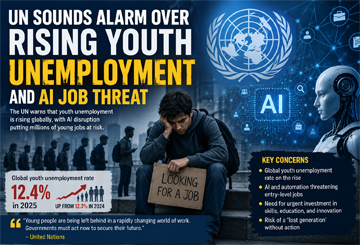
UN Sounds Alarm Over Rising Youth Unemployment and AI Job Threat
Global youth unemployment increased last year, with some of the sharpest rises recorded in high-income countries as artificial intelligence and slowing economic growth continue to reshape the global labour market, the United Nations’ labour agency said Tuesday.
According to the International Labour Organization’s (ILO) Global Employment Trends for Youth 2026 report, the global youth unemployment rate rose from 12.3% in 2024 to 12.4% in 2025. The increase represents around 67 million unemployed young people aged between 15 and 24.
The ILO also reported a slight rise in the number of young people who are not in employment, education or training, commonly known as NEET. Their share increased to 20%, affecting more than 257 million young people worldwide.
The findings indicate that the tentative recovery in youth labour markets seen after the Covid-19 pandemic has lost momentum.
The annual report, first published in 2004, provides an overview of youth employment trends and labour-market conditions across different regions of the world.
The latest assessment found that some of the largest increases in youth unemployment occurred in wealthier economies, raising concerns about the prospects of young people entering the workforce.
The ILO attributed the worsening situation to a combination of slower global economic growth, weaker job creation, geopolitical tensions and rapid technological change.
“These factors are making the transition from education to decent employment increasingly difficult for millions of young people,” the report said.
The ILO expects the global youth unemployment rate to remain broadly stable at around 12.3% in both 2026 and 2027.
However, the agency warned that simultaneous increases in youth unemployment and the NEET rate would be a particularly concerning development.
Sara Elder, head of the ILO’s employment analysis and economic policy unit, said that when both indicators rise together, it represents a warning sign for policymakers.
AI Fuels Anxiety Among Young Workers
The growing influence of artificial intelligence is also contributing to uncertainty among young people, although the ILO said it is still too early to establish a direct causal link between AI and rising youth unemployment.
Young workers are increasingly concerned that automation and emerging technologies could replace jobs, limit opportunities for career development and make stable employment harder to secure.
Sukti Dasgupta, director of the ILO’s employment, skills and sustainable enterprises department, said the connection between AI and unemployment required further research.
She acknowledged, however, that the timing of the developments was significant, describing the global economy as being in a period of “great uncertainty and fragility”.
The report highlighted a decline in several occupations that have traditionally provided young people with their first opportunities in the labour market. These include office and administrative jobs, sales positions and certain manufacturing roles.
ILO Director-General Gilbert Houngbo warned that prolonged difficulties in finding decent employment could have serious consequences for an entire generation.
“When young people are locked out of quality employment, countries lose talent, productivity and social cohesion,” Houngbo said.
He stressed that creating decent jobs for young people should be viewed not only as a social responsibility but also as an important economic investment.
Regional Youth Unemployment Trends
Youth unemployment increased significantly in several parts of the world, including northern Africa, northern America and northern, southern and western Europe.
In central and western Asia and eastern Europe, the decline in youth unemployment was accompanied by an increase in the number of young people classified as NEET, highlighting continued challenges in moving young people into education, training or employment.
Latin America and the Caribbean recorded declines in both youth unemployment and NEET rates. However, the ILO noted that these improvements were partly influenced by shrinking youth populations in the region.
The Arab states and northern Africa continued to record the world’s highest youth unemployment rates, at 26.2% and 22.6%, respectively.
The ILO said the continued increase in unemployment in regions where rates are already exceptionally high points to deep-rooted structural barriers preventing young people, particularly young women, from fully participating in productive economic activity.
The report warned that without stronger efforts to create quality employment and improve access to education and skills development, millions of young people could face prolonged uncertainty at the beginning of their working lives.
The findings underline the growing challenge facing governments worldwide: ensuring that technological transformation, including the rapid expansion of artificial intelligence, creates opportunities for young workers rather than further limiting their prospects.
